Resistance Bands: The Complete Guide to Types, Buying and Training
This article may contain affiliate links. If you make a purchase through these links, we may earn a small commission at no extra cost to you. This helps us keep creating free content.
Hinweis: Dieser Artikel ersetzt keine ärztliche Beratung. Besprich Trainingsfragen im Zweifel mit Arzt oder Physiotherapie.
Resistance bands deliver strength gains comparable to free weights for most exercises, yet a full set costs under $40 and fits in a kitchen drawer. That combination of low price, low impact and tiny footprint makes them the single most useful piece of equipment for a home gym in a small space. The trade-off is that bands behave differently from dumbbells: the resistance climbs as you stretch them, the tension can be awkward to measure, and cheap latex perishes. This guide explains every band type, what each one is for, how to pick the right resistance, and how to build a workout that actually progresses.
The main types of resistance band
There are five common formats, and they are not interchangeable. A loop band that suits glute work is useless for a chest press, and a heavy power band that helps with pull-ups will overpower a shoulder rehab move. Buying the wrong shape is the most common first mistake, so match the band to the job before you spend anything.
The table below covers the five formats you will actually see for sale, what each is best at, a rough US retail range, and the catch to watch for. Prices are approximate and move with brand and material.
| Band type | Best for | Approx. US price | Notes |
|---|---|---|---|
| Mini loops (fabric or latex) | Glutes, hips, knee and shoulder activation, warm-ups | $10–18 (set of 3–5) | Fabric versions don't roll or pinch; latex ones can |
| Tube bands with handles | Pressing, rows, curls, gym-machine-style moves | $20–40 (stackable set) | Handles fail before the tube does; check the clips |
| Long loop / power bands | Pull-up assistance, heavy pulls, mobility | $10–25 each | Resistance jumps fast between colours |
| Therapy / flat bands | Rehab, gentle strength, older beginners | $8–15 (roll or pack) | Lowest tension; ideal for shoulders and ankles |
| Figure-8 and ring bands | Upper-body isolation, arms, light shoulders | $8–14 | Fixed length limits exercise range |
How resistance is measured (and why it lies)
Fit Simplify Resistance Bands Set
Five resistance levels in a kit that fits in a drawer, gentle on the joints.
As an Amazon Associate we earn from qualifying purchases.
Band resistance is usually printed in pounds, such as 10 lb, 20 lb or 30 lb. That figure is close to meaningless on its own, because a band only delivers its rated tension at a specific stretch, often around 250 to 300 percent of its resting length. Stretch it less and you get less; stretch it more and you get more. A 20 lb band at a short range might feel like 8 lb, and at full stretch like 35 lb.
This is why two people can call the same band easy or brutal. What matters in practice is matching the band to the exercise range. For a bicep curl you barely stretch the band, so pick a higher rating. For a lateral raise where your arm travels far, a lower rating gives the same felt effort. Buy a graduated set rather than one band so you can swap up or down by exercise.
Colour codes are not standardised across brands. Yellow might be lightest for one maker and mid-range for another. Trust the printed pound rating and your own felt effort, never the colour, when you move between brands.
Choosing your first set of resistances
For a single adult starting from scratch, a five-band stackable tube set spanning roughly 10 to 50 lb (often sold as 100–150 lb combined) covers almost everything. You stack two or three tubes onto the handles to dial the load up, which gives you fine control that single bands lack. A typical set runs $25 to $40.
Add one light therapy band or a pack of mini loops for warm-ups and shoulder work, where the tube set is too strong to be useful. If pull-ups are a goal, add one or two long power bands in the 25–80 lb assist range. That three-part kit, around $50 to $70 total, replaces a rack of dumbbells for a beginner.
- Core set: stackable tubes with handles, ankle straps and a door anchor (your main load).
- Warm-up and rehab: a pack of mini loops or one light flat band.
- Pulling and mobility: one or two long loop bands if you want assisted pull-ups or deep stretches.
The exercises bands do better than weights
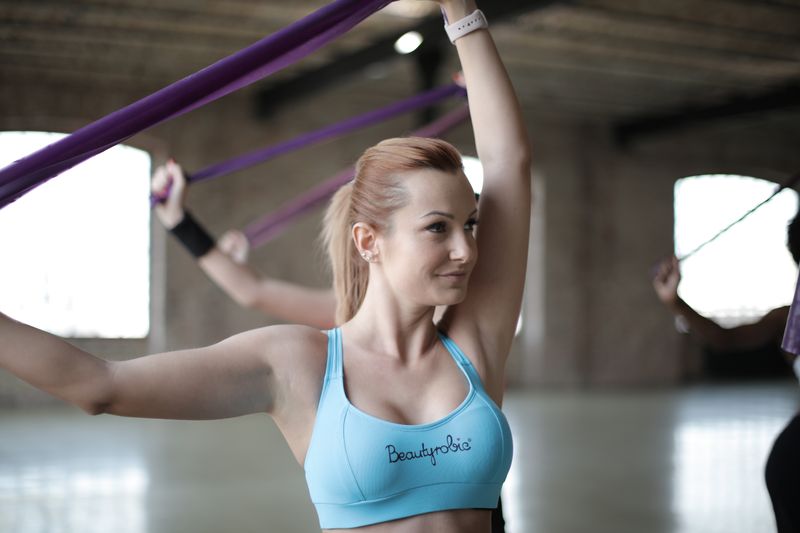
Bands win clearly for any pulling movement done at home. Rows, face pulls, pull-aparts and lat work need a cable or a bar with weights, both bulky and expensive. A band and a door anchor replace all of it for a few dollars. The ascending tension also suits these moves, because your pulling muscles are strongest at the contracted end where the band is hardest.
Bands also win for joint-friendly training. There is no load slamming through your knees or wrists at the bottom of a movement, because tension is lowest where you are weakest and highest where you are strongest. That makes them a sensible choice for older beginners, anyone returning from injury, and apartment dwellers who can't drop a dumbbell at 6 a.m.
Where free weights still lead is heavy lower-body work. Loading a squat past your bodyweight with bands gets awkward and the tension curve fights you. For a complete leg session, bands plus a single adjustable kettlebell or dumbbell beats bands alone.
How to progress with bands
Progression confuses people because you can't just add 5 lb to a band the way you would a barbell. You have four levers instead. First, move to a heavier band or stack an extra tube. Second, shorten your grip or stance to start with more pre-stretch, which raises tension across the whole range. Third, slow the lowering phase to three or four seconds, which makes a given band far harder. Fourth, add reps or sets.
A workable plan is to keep reps in the 10 to 15 range per set, add reps week to week until you hit the top of that range across all sets, then step up tension and drop back to the bottom of the range. This mirrors how barbell programmes add weight, just with band tension as the variable. Log what you do, because felt effort drifts and memory flatters you.
Care, lifespan and replacement
Latex bands perish. Heat, sunlight, sweat and oils all degrade the rubber, and a band that has gone shiny, sticky or chalky is on borrowed time. Store bands away from radiators and windows, wipe sweat off after use, and dust latex with a little talc or cornstarch if it gets tacky. Treated well, a quality latex band lasts two to four years of regular use.
Fabric loop bands and well-made tube sets last longer because the working part isn't bare latex. The weak point on tube sets is the handle and clip, not the tube, so check those each session. Replace any band the moment you see a tear or a thinning spot, since the failure is sudden, not gradual. At $10 to $40 a set, replacement is cheap insurance against a snap to the face.
Bands versus dumbbells, cable machines and bodyweight
Against dumbbells, bands win on price, storage, noise and pulling exercises, and they lose on heavy lower-body loading and on the simple certainty of a known fixed weight. For a small apartment, bands are the better single buy, with one adjustable dumbbell added later for heavy squats and lunges. That pairing covers more ground than either alone and still fits under a bed.
Against a cable machine, a tube band with a door anchor reproduces most of the same movement paths for one or two percent of the cost and none of the floor space. The machine offers a smoother, more consistent resistance and heavier top-end loads, which serious lifters will eventually want. For everyone training at home for general strength and health, the band covers the need.
Against pure bodyweight training, bands add scalable resistance to moves that bodyweight alone can't load well, such as rows, curls and lateral raises, and they let you assist hard moves like pull-ups. Bodyweight needs no kit at all, which is its own advantage. Combining the two, bodyweight for pushing and squatting plus bands for pulling and isolation, gives a complete programme for almost nothing.
A simple three-day band programme
You don't need a complicated split to make progress with bands. Three short full-body sessions a week, each hitting a push, a pull, a squat or hinge, and one arm or shoulder move, drives steady gains for most people. Keep each exercise to two or three sets of 10 to 15 reps and rest about a minute between sets.
| Day | Push | Pull | Legs | Extra |
|---|---|---|---|---|
| Monday | Band chest press | Bent-over row | Band squat | Biceps curl |
| Wednesday | Overhead press | Face pull | Romanian deadlift | Triceps press-down |
| Friday | Push-up + band | Lat pulldown (anchor high) | Lunge with band | Lateral raise |
Warm up for five minutes with band pull-aparts and light reps before each session. Run the same exercises for a few weeks while adding reps, then increase band tension and start the rep range again. Track your sets so progress is a fact you can see, not a feeling you hope for.
Frequently asked questions
Can resistance bands build real muscle?
Yes. Muscle responds to tension and effort, not to the specific tool delivering it. Studies comparing bands with free weights find similar strength and size gains when the effort and reps match. The ceiling is lower for very strong lifters on heavy lower-body lifts, but for most home trainees bands build meaningful muscle.
What resistance band should a complete beginner buy?
A stackable tube set with handles, ankle straps and a door anchor, spanning roughly 10 to 50 lb, for $25 to $40. Add a pack of mini loops for warm-ups. That handles the large majority of exercises without overspending.
How long do resistance bands last?
Quality latex bands last two to four years with regular use if kept out of heat and sunlight and wiped clean. Fabric loops and tube sets often last longer. Replace any band at the first sign of a nick, tear or chalky patch.
Are bands or dumbbells better for a small apartment?
Bands, for most people in a small apartment. They store in a drawer, make no noise, can't dent a floor, and cover pulling exercises that dumbbells can't do without a bench and rack. Keep one adjustable dumbbell or kettlebell alongside them for heavy leg work.
Why do my bands feel weaker than the label says?
Because the printed pound rating only applies at a specific stretch, usually around three times the band's resting length. At a shorter range you feel far less than the label. Match a higher-rated band to short-range moves like curls and a lighter one to long-range moves like lateral raises.
Do I need a door anchor?
For tube and loop bands, a door anchor roughly triples the exercises you can do, unlocking rows, presses, pulldowns and chops from a single fixed point. It costs a few dollars and is often included in tube sets. It is the highest-value accessory you can add.
Are fabric or latex bands better?
Fabric bands don't roll, pinch or snap, and they last longer, which makes them the better pick for mini loops used on the hips and legs. Latex gives a smoother, more continuous tension and comes in the long and tube formats that fabric can't replace. Most people end up with fabric mini loops and latex tubes, each doing what it does best.
How many bands do I actually need?
Two or three. A stackable tube set counts as one purchase that spans a wide range, a pack of mini loops covers warm-ups and lower-body activation, and one long power band handles assisted pull-ups and deep mobility. Beyond that you are buying duplicates rather than capability.
Can I do a full workout with bands alone?
Yes, for general strength and conditioning. Bands cover every push, pull, squat, hinge and isolation movement a beginner or intermediate trainee needs. The one gap is very heavy lower-body loading, which an adjustable dumbbell or kettlebell fills cheaply if and when you outgrow the bands.
Accessories worth buying and ones to skip
A door anchor and a pair of ankle straps are the two accessories that meaningfully expand what bands can do, turning a basic set into a near-complete cable station for under $15 extra. Most quality tube sets include both, so check before buying separately. A small carry pouch keeps everything in one drawer and stops loops migrating around the house.
Padded handles are a comfort upgrade rather than a necessity, useful if grip discomfort cuts your sets short. Skip novelty add-ons like vibration handles or branded workout cards, which add cost without adding capability. The money is far better spent on a second tube set for heavier progression once you outgrow the first.
🛠️ Free tools for this topic
No sign-up. They do the calculating and checking for you.
Published by the Gym4Home editorial team. Published June 9, 2026. Updated October 4, 2026.
Editorial responsibility: see Imprint.
Spotted an error or have something to add? corrections@gym4home.com
Home Gym Tips, Weekly
Equipment picks, workout ideas, and setup guides — for every space and every budget. No fluff, just useful.
🎁 Free bonus: The Home Gym Starter Checklist (PDF)
You might also like
Resistance Bands: Loop vs Tube, Which Should You Buy?
Loop vs tube resistance bands compared by use, grip, durability, and price, with a clear recommendation on which to buy first for a home gym.
Foam Roller Guide: Types, Density and How to Use One
A practical foam roller guide covering density, length and texture, how to pick your first roller, and a step-by-step routine for the main muscle groups.
How Many Sets and Reps Should You Do in a Home Gym?
How many sets and reps to do at home for strength, muscle, or endurance, with rest times, loading tips, and a sample beginner week.
📖 All articles on Gym4Home →
Browse our other articles