Best Resistance Bands for a Home Gym in 2026
This article may contain affiliate links. If you make a purchase through these links, we may earn a small commission at no extra cost to you. This helps us keep creating free content.
Hinweis: Dieser Artikel ersetzt keine ärztliche Beratung. Besprich Trainingsfragen im Zweifel mit Arzt oder Physiotherapie.
A full set of resistance bands costs $20 to $60 and replaces a rack of dumbbells that would run ten times that and fill a closet. Bands store in a drawer, travel in a carry-on, and put almost no shock through the knees, shoulders, or lower back. That combination is why they earn a spot in nearly every apartment and spare-room setup, whether you are 35 or 65.
Not all bands are built the same, though. There are three very different products sold under the same name, and buying the wrong type for your goal is the most common mistake. This breakdown sorts them by what you actually want to do, names specific sets with rough US retail prices, and flags the durability traps that ruin cheap bands within a month.
The three band types, and which one you need
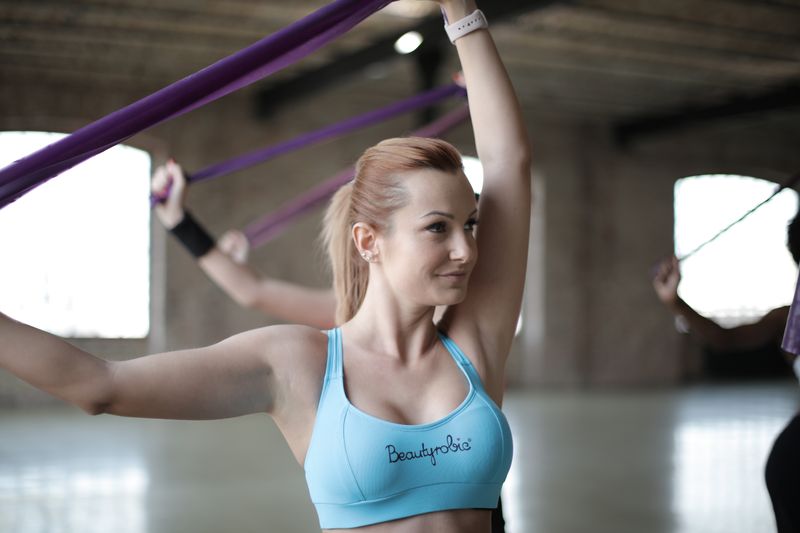
Loop bands (sometimes called pull-up assist bands) are continuous rubber loops, usually 41 inches long, sold in graduated thicknesses. They anchor to a bar or doorframe and handle heavy compound work: assisted pull-ups, banded squats, deadlift accessory pulls. A five-band set runs $25 to $45.
Tube bands with handles are the type most people picture: a rubber tube with a clip handle at each end, often sold with a door anchor and ankle straps. They suit chest presses, rows, curls, and shoulder work where you want a grip rather than a loop wrapped around your hand. Stackable sets that clip together for more resistance cost $30 to $60.
Mini loop bands are the short, flat fabric or latex loops, around 12 inches, for glute bridges, lateral walks, and clamshells. They are a $12 to $20 add-on, not a standalone gym. Most people end up owning a tube set plus a pack of mini loops.
Comparison: the main sets worth buying
Fit Simplify Resistance Bands Set
Five resistance levels in a kit that fits in a drawer, gentle on the joints.
As an Amazon Associate we earn from qualifying purchases.
| Set type | Best for | Rough US price | Watch for |
|---|---|---|---|
| Graduated loop set (5 bands) | Pull-up assist, heavy lower body | $25–45 | Snapback if anchored badly |
| Tube set with handles + door anchor | Upper-body presses, rows, curls | $30–60 | Clip and handle failure |
| Fabric mini loops (3-pack) | Glutes, hips, warm-ups | $12–20 | Sizing too tight |
| All-in-one bundle | Beginners who want everything | $35–70 | Filler bands you never use |
For a single first purchase covering the widest range of exercises, a stackable tube set with a door anchor is the strongest pick. It lets you press, row, and curl from day one, and you add resistance by clipping on a second tube rather than buying a whole new band. Add a fabric mini-loop pack later when you start caring about glute and hip work.
How to size resistance without printed pounds
Band "pounds" are marketing numbers, not calibrated weights. A band rated at 30 pounds gives you 30 only at a specific stretch length, and far less near the start of the range. Treat the color and rating as a rough ranking within one brand, never across brands.
Size by feel instead. Pick a resistance where the last two or three reps of a set of twelve are clearly hard but your form holds. If you can rip out twenty clean reps, it is too light; if you stall at six, it is too heavy for that movement. Owning three resistance levels covers almost every exercise, since you naturally use lighter tension for shoulders and heavier for legs.
Durability: where cheap bands fail
Latex bands die at stress points, not in the middle. On tube sets, the first failure is almost always where the rubber meets the metal clip, because that junction takes every bit of load. Sets with the tube molded into a solid plastic collar last far longer than ones where a thin tube is crimped into a hook.
Loop bands fail from surface cracking caused by sunlight, heat, and chalk. Store them in a drawer or bag, away from a sunny windowsill, and wipe off sweat. A $40 set treated this way lasts years; the same set left baking on a garage shelf can crack in a single summer.
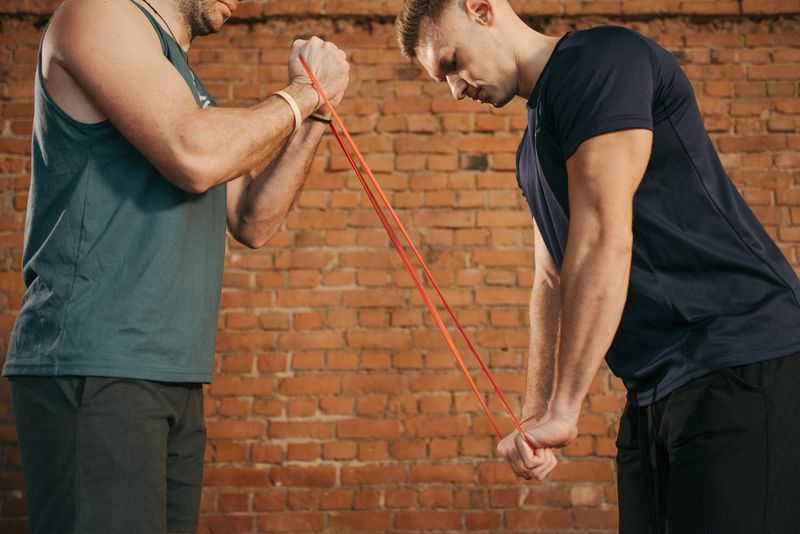
Fabric bands almost never snap, but they do stretch out and lose tension over many months. That is a gradual, predictable decline rather than a sudden break, which is one reason they are popular with anyone nervous about a band letting go mid-rep.
Building a real workout with bands
Bands cover every major movement pattern, so you can run a full-body routine off one tube set and a door anchor. The trick is matching the anchor height to the movement: low anchor for rows and curls, high anchor for lat pulldowns and triceps work, no anchor for presses where you wrap the band behind your back.
| Exercise | Anchor | Sets x reps |
|---|---|---|
| Banded chest press | Behind back | 3 x 12 |
| Standing row | Low / door | 3 x 12 |
| Lat pulldown | High / door top | 3 x 12 |
| Banded squat | Under feet | 3 x 15 |
| Glute bridge (mini loop) | Above knees | 3 x 15 |
Two to three rounds of that list, three times a week, is a complete strength stimulus for most people training at home. As exercises get easy, shorten your grip on the band or step further from the anchor to raise the tension rather than buying heavier gear.
Who should skip bands
Bands are not the right primary tool if your main goal is maximal strength on a barbell squat or deadlift, where you need a true loadable weight that does not change tension through the range. They also frustrate anyone who hates the rubbery feel under tension or who wants a fixed, repeatable load they can log to the pound.
For everyone else building a compact, joint-friendly setup, a $40 tube set plus a $15 mini-loop pack is one of the best value buys in home fitness. Start there, train consistently, and add a doorframe pull-up bar before you ever think about heavier dumbbells.
Latex versus fabric, and what about allergies
Most loop and tube bands are natural latex, which gives the smoothest, springiest tension and the highest strength-to-thickness ratio. The downside is that a small number of people have a latex allergy, and even those who do not may notice a rubbery smell on a new set that fades over a week or two. If latex is a problem for you, look specifically for TPE or fabric bands, which skip the allergen entirely.
Fabric bands have improved a lot and now come in tube and longer-loop versions, not just mini loops. They cost a few dollars more than latex for the same resistance, feel softer against the skin, and do not snap. The trade-off is a slightly less linear pull and a bulkier band that does not pack quite as small. For glute and hip work especially, most people prefer fabric now.
Accessories that make a band set actually usable
A tube set is only as good as its anchor. The door anchor that comes bundled is the single most-used accessory, since it turns any closed door into a cable station for rows, pulldowns, and triceps work. Check that the door anchor has a thick foam stopper, because thin ones can mark or dent a door over time.
Ankle straps widen what a tube set can do, adding standing kickbacks, hip abduction, and lower-body cable-style work without a loop cutting into your skin. A small carabiner or two lets you swap bands and stack resistance in seconds rather than fiddling with clips. None of these cost more than a few dollars, and together they roughly double the exercise menu of a basic set.
| Add-on | What it unlocks | Rough US price |
|---|---|---|
| Door anchor | Rows, pulldowns, triceps | $6–12 |
| Ankle straps | Kickbacks, hip work | $8–15 |
| Carabiners | Fast band swaps, stacking | $5–10 |
| Handles (spare) | Comfort, grip variety | $8–14 |
Buy the tube set as a bundle that already includes the anchor and straps rather than piecing it together, since bundles almost always cost less than the parts bought separately. Once you have those, a band gym does nearly everything a cable machine does at a fraction of the price and footprint. Keep a spare door anchor in a travel bag and your full workout fits in a side pocket, which is the real reason bands outlast every other piece of home equipment people buy.
🛠️ Free tools for this topic
No sign-up. They do the calculating and checking for you.
Published by the Gym4Home editorial team. Published July 22, 2026. Updated October 4, 2026.
Editorial responsibility: see Imprint.
Spotted an error or have something to add? corrections@gym4home.com
Home Gym Tips, Weekly
Equipment picks, workout ideas, and setup guides — for every space and every budget. No fluff, just useful.
🎁 Free bonus: The Home Gym Starter Checklist (PDF)
You might also like
Resistance Bands: Loop vs Tube, Which Should You Buy?
Loop vs tube resistance bands compared by use, grip, durability, and price, with a clear recommendation on which to buy first for a home gym.
Foldable Weight Bench Review 2026: Picks for Small Home Gyms
The best foldable weight benches for 2026, compared by type, price and build quality, with buying rules for stable pressing in a small home gym.
Resistance Bands: The Complete Guide to Types, Buying and Training
A full guide to resistance band types, how band resistance really works, what to buy first, and how to progress your training over time.
📖 All articles on Gym4Home →
Browse our other articles