How to Start Exercising at Home After 50: A Practical Plan
This article may contain affiliate links. If you make a purchase through these links, we may earn a small commission at no extra cost to you. This helps us keep creating free content.

Hinweis: Dieser Artikel ersetzt keine ärztliche Beratung. Besprich Trainingsfragen im Zweifel mit Arzt oder Physiotherapie.
Health note: This article is for general information only and is not a substitute for medical advice. Talk to your doctor before starting a new exercise programme, especially if you have an existing health condition or injury.
Muscle mass drops by roughly 3 to 8 percent per decade after age 30, and the rate speeds up after 50. That loss is the main reason stairs feel harder and grocery bags feel heavier, and it is also the part you can change the fastest at home. Two short strength sessions a week can rebuild meaningful strength inside a couple of months, with no gym membership and no commute.
Starting at home after 50 is mostly about getting the first four weeks right: low equipment cost, joint-friendly movements, and a schedule you will actually keep. The plan below walks through what to buy, how to warm up, the exercises to start with, how to progress, and the mistakes that send people back to the couch.
Why home training works well after 50
A home setup removes the two biggest reasons older adults skip workouts: travel time and self-consciousness. You can train in five-minute pockets, in whatever you slept in, and nobody is waiting for the rack you are using. For anyone managing knees, a back, or a shoulder, training alone also means you set the pace and stop the second something feels wrong.
The cost case is just as clear. A commercial membership runs $30 to $60 a month in most US cities, so a year is $360 to $720. A starter kit of bands, a pair of adjustable dumbbells, and a mat costs about $150 to $250 once, and it lasts for years. You break even in roughly four to six months and own the equipment after that.
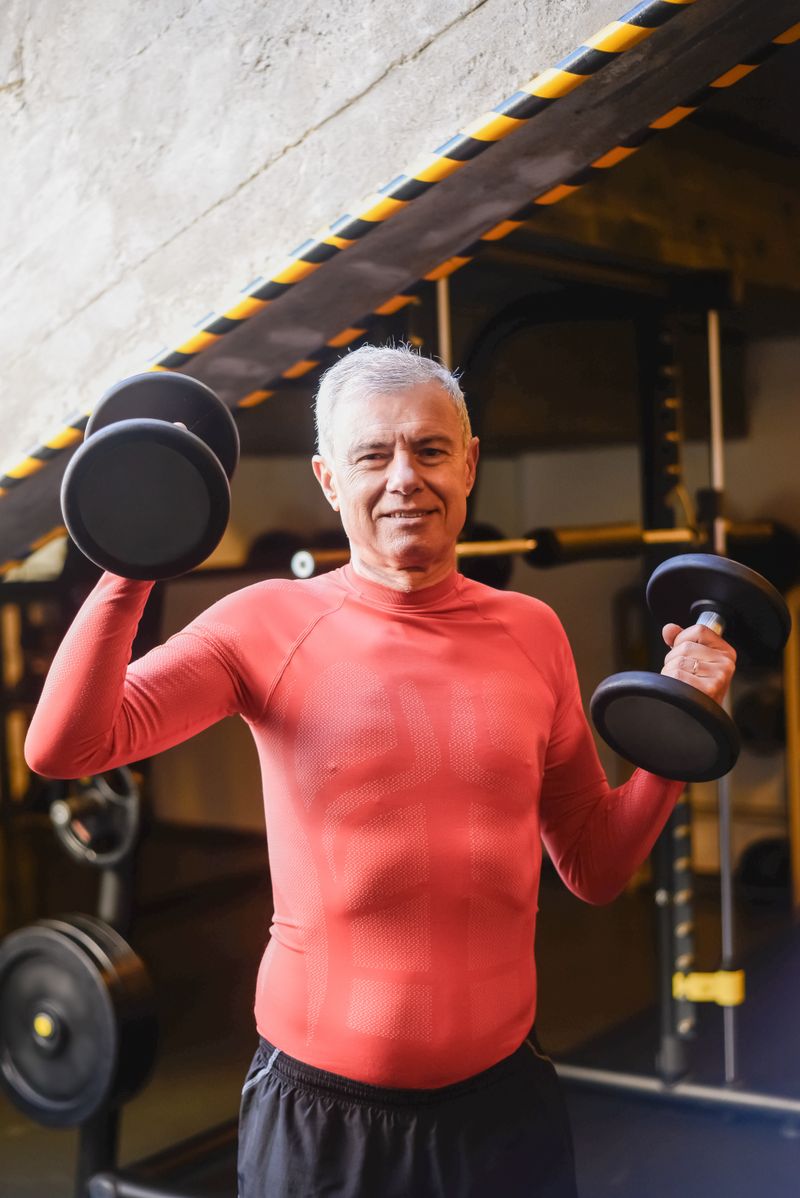
The starter kit and what it costs
Fit Simplify Resistance Bands Set
Five resistance levels in a kit that fits in a drawer, gentle on the joints and ideal to start with.
* Affiliate link. We may earn a commission at no extra cost to you.
You do not need a power rack or a treadmill to begin. A small, well-chosen kit covers full-body strength and fits in a closet. Buy in this order, and stop whenever your budget says so, because even the first two items are enough to start.
| Item | Approx. US price | Why it earns its place |
|---|---|---|
| Resistance band set (loops + tubes) | $20–35 | Lightest joint load, scalable, packs flat |
| Exercise mat | $20–40 | Cushions floor work, protects knees and spine |
| Adjustable dumbbells (light pair) | $80–150 | One pair replaces a full light rack, 5–25 lb range |
| Sturdy chair (already own one) | $0 | Sit-to-stand, incline push-ups, balance support |
| Doorframe pull-up bar (optional) | $25–35 | Assisted rows and hangs, no drilling |
Apartment dwellers should favor bands and dumbbells over anything that drops or thuds. Bands are silent, and a pair of dumbbells set down gently will not bother a neighbor below. Skip kettlebell swings and box jumps in an upstairs unit. The chair and the mat do most of the quiet work in the early weeks.
Warm up so your joints cooperate
A cold start is where older joints get cranky, so give yourself five to eight minutes before the first real set. The goal is to raise your temperature and move each joint through its range, not to tire yourself out. March in place, roll your shoulders, do slow arm circles, and add a few gentle bodyweight squats to the depth that feels easy.
Pay special attention to the joints you already know are touchy. If your knees talk to you, add slow seated leg extensions with no weight. If a shoulder is the issue, do wall slides and band pull-aparts before any pressing. A warm joint moves through more range with less complaint, which lowers your injury risk on the working sets.
Your first four exercises
Four movements cover the whole body for a beginner: a squat pattern, a push, a pull, and a hinge. Start with the easiest version of each, do them slowly, and stop two reps short of failure. Many people find that controlled, slightly-too-easy reps build confidence faster than grinding hard sets that leave them sore for days.
- Sit-to-stand (squat pattern): From a sturdy chair, stand up without using your hands, then sit back down under control. This is the most useful movement for daily life. Make it harder by slowing the lowering phase or holding a light dumbbell at your chest.
- Incline push-up (push): Hands on a counter or the back of a heavy sofa, body in a straight line, lower your chest toward your hands and press back. The higher your hands, the easier it is. Lower the surface over weeks as you get stronger.
- Band row (pull): Anchor a band in a closed door at chest height, hold both ends, and pull your elbows back, squeezing your shoulder blades together. This balances all the pushing and helps round shoulders.
- Hip hinge to band pull (hinge): Stand on a band, hold the ends, push your hips back with a flat back, then stand tall and squeeze your glutes. This trains the posterior chain that protects your lower back.
How to schedule your first eight weeks
Two full-body sessions a week is the right starting dose for most people over 50, with at least one rest day between them. Three sessions are fine once two feel comfortable. More is not better in the beginning, because recovery is where the strength actually gets built, and recovery is slower after 50 than it was at 30.
Run each exercise for two sets of 8 to 12 slow reps in weeks one and two, then add a third set in weeks three and four. From week five, nudge the difficulty: a slightly heavier dumbbell, a lower push-up surface, or a thicker band. The table below shows a simple ramp you can follow without overthinking it.
| Weeks | Sessions/week | Sets per exercise | Focus |
|---|---|---|---|
| 1–2 | 2 | 2 × 8–12 | Learn the movements, easy load |
| 3–4 | 2 | 3 × 8–12 | Add volume, stay easy |
| 5–6 | 2–3 | 3 × 8–12 | Add a little resistance |
| 7–8 | 3 | 3 × 10–15 | Progress load or harder variation |
Add gentle cardio and balance work
Once the strength habit sticks, layer in 20 to 30 minutes of easy cardio two or three times a week. A daily walk is the most underrated tool you own, and it costs nothing. Indoors, marching in place during a TV show, a cheap mini-stepper, or a used recumbent bike all keep the impact off your knees while raising your heart rate.
Aim for cardio at an effort where you can still hold a conversation but would struggle to sing. That talk-test pace covers most of the heart and lung benefit without the strain that pushes blood pressure up. If you have not done any cardio in a while, start with ten minutes and add a few minutes each week rather than trying to hit thirty on day one.
Balance work belongs in every over-50 routine because falls are the main threat to independence. Practice standing on one foot near a counter for support, holding 10 to 20 seconds per side. Heel-to-toe walking across a room and slow weight shifts also help. Thirty seconds of balance work at the end of a session adds up over months.
Set up a small training space at home
You need surprisingly little room to train. A clear patch about 6 by 6 feet is enough for everything in this plan, since the movements are done standing, seated in a chair, or on a mat. A corner of the bedroom, a stretch of hallway, or the foot of the bed all work. The point is to have a spot ready so nothing stands between you and the session.
Keep the equipment visible rather than buried in a closet. A band hung on a hook and dumbbells parked by the chair remove the friction that kills routines. If you live in an apartment, a mat under the dumbbells dampens sound and protects the floor, and silent bands let you train early without waking anyone. Good lighting and a clear path also lower the trip risk in the space.
Pick a regular time and attach it to something you already do, like a workout right after your morning coffee or before an evening show. Tying the session to an existing habit is what turns it from a decision you make each day into a routine you simply follow. The setup matters less than showing up to it twice a week.
Track progress so you stay motivated
Write down what you did after each session: the exercises, the sets, the reps, and the weight or band used. A cheap notebook beats memory, and seeing the numbers climb over weeks is the clearest proof the work is paying off. When a weight starts to feel easy, the log tells you it is time to nudge it up.
Watch for the wins that do not show on a scale. Standing from a low chair without using your hands, carrying both grocery bags in one trip, or climbing the stairs without pausing are the results that matter most after 50. Many people find these everyday improvements arrive before any change in the mirror, and they are the real reason to keep going.
Common mistakes that derail beginners
Doing too much in week one is the classic error. Enthusiasm leads to long, hard first workouts, then three days of soreness convince you that exercise hurts and you quit. Start lighter than your ego wants. You should finish the first sessions thinking you could have done more, because that is exactly what keeps you coming back.
Skipping the warm-up and ignoring sleep are the next two traps. Cold joints get injured, and muscle rebuilds during sleep, so seven to eight hours does more for your progress than an extra set. Protein matters as well: spreading 20 to 30 grams across each meal gives your muscles the raw material to rebuild after training.
Frequently asked questions
Is it too late to start strength training at 60 or 70? No. Studies on adults in their 80s and 90s show meaningful strength and muscle gains from resistance training. The body responds to training at any age. You start where you are and progress from there.
How long until I see results? Many people find daily tasks feel easier within three to four weeks, before any visible change. Strength gains in the first month come largely from your nervous system learning the movements. Visible muscle and bigger strength jumps usually show by weeks eight to twelve.
What if I have arthritis or a bad knee? Strength training often helps joint pain by building the muscle that supports the joint, but the right exercises vary by person. Stick to pain-free range, favor bands and slow tempos, and ask your doctor or a physio which movements suit your specific situation.
Do I need protein supplements? Most people can hit their protein target from food: eggs, dairy, chicken, fish, beans, and lentils. A protein powder is a convenience, not a requirement. Aim for protein at each meal rather than a single large dose.
How much should I spend to start? You can begin with a $20 band set and a chair you already own. A fuller kit with adjustable dumbbells and a mat runs about $150 to $250 once. That is still far less than a year of gym fees, and you keep the gear.
Should I do cardio or strength first? Build strength first if you only have time for one, because it protects independence and bone. If you do both in one session, do the strength work while you are fresh and finish with the easy cardio.
How many days a week should I exercise? Two strength sessions plus two or three short walks is a realistic, effective weekly plan for most people over 50. You can add a third strength day once two feel comfortable. Rest days are not wasted days, because muscle and joints repair between sessions and that repair is the point.
Is it safe to exercise with high blood pressure or heart disease? Many people with well-managed conditions exercise safely and benefit from it, but this is exactly the situation where you clear the plan with your doctor first. They can flag any movements to avoid and set sensible limits. Avoid holding your breath during lifts, since that spikes blood pressure, and breathe out on the effort instead.
What should I do on days my joints feel stiff? A gentle walk, some easy mobility, and a longer warm-up often loosen stiff joints rather than make them worse. If a joint is painful rather than just stiff, rest it and train the rest of the body, then check with a professional if the pain lingers. Movement within a comfortable range is usually better than total rest for everyday stiffness.
🛠️ Free tools for this topic
No sign-up. They do the calculating and checking for you.
Published by the Gym4Home editorial team. Published June 18, 2026. Updated August 23, 2026.
Editorial responsibility: see Imprint.
Spotted an error or have something to add? corrections@gym4home.com
Home Gym Tips, Weekly
Equipment picks, workout ideas, and setup guides — for every space and every budget. No fluff, just useful.
🎁 Free bonus: The Home Gym Starter Checklist (PDF)
You might also like
Home Gym for Seniors: The Complete Guide to Getting Started
A complete, practical guide to building a joint-friendly home gym after 50: what to buy in what order, the four pillars of older-adult fitness, a sample weekly routine, safety, and how to progress and stay consistent.
Arthritis-Friendly Home Exercises (Gentle, Joint-Safe Routines)
Gentle, low-impact home exercises for people with stiff or sensitive joints: warm-up, joint-friendly strength moves, low-impact cardio, and safe recovery.
Best Adjustable Dumbbells for Older Adults: A Practical Buying Guide
A practical guide to choosing adjustable dumbbells for older adults, comparing dial and pin systems, weight ranges and grip-friendly features with US prices.
📖 All articles on Gym4Home →
Browse our other articles