Seated Resistance Band Workout for Seniors: 8 Exercises You Can Do in a Chair
This article may contain affiliate links. If you make a purchase through these links, we may earn a small commission at no extra cost to you. This helps us keep creating free content.
Health note: This article is for general information only and is not a substitute for medical advice. Talk to your doctor before starting a new exercise programme, especially if you have an existing health condition or injury.
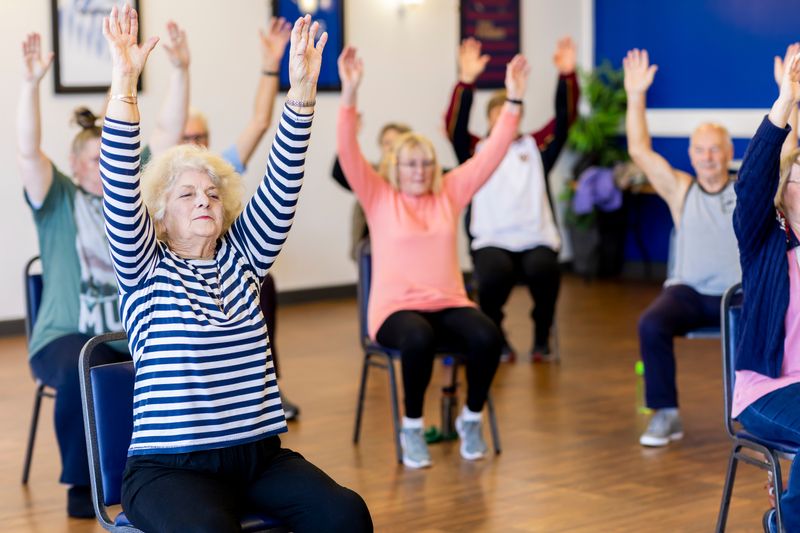
A sturdy kitchen chair and one resistance band are enough to train your whole body without ever standing up. Seated band work lets older adults build strength safely, with no risk of losing balance and almost no impact on the joints. The band provides the resistance; the chair provides the stability. That combination is why seated band routines are a staple in physical therapy and senior fitness classes.
The eight exercises below cover the arms, shoulders, back, chest, and legs. Each one names the movement, explains how to set it up in the chair, and gives sets and reps in a table you can follow. Start light, move slowly, and stop any exercise that causes sharp pain.
What you need and how to set up the chair
Use a stable chair without wheels and without arms, or with arms low enough not to get in the way. A dining or kitchen chair is ideal. Place it on a non-slip surface or a rug that grips the floor. Sit tall with your feet flat and hip-width apart, which gives you a solid base for every movement.
For resistance, a light loop band or a long flat therapy band works best. These often come in colour-coded tensions, with yellow or red being the lightest. A set of three light-to-medium bands costs roughly $10 to $18 and gives you room to progress. Avoid heavy tube bands with handles at first; they make it harder to control the movement from a seated position.
The seated full-body routine
Fit Simplify Resistance Bands Set
Five resistance levels in a kit that fits in a drawer, gentle on the joints.
* Affiliate link. We may earn a commission at no extra cost to you.
Do these eight exercises in order. Move slowly, especially on the return phase, and keep breathing. Beginners do one round; build to two rounds as the movements become comfortable. Rest 30 to 60 seconds whenever you need it.
1. Seated row. Loop the band around both feet and hold an end in each hand. Sit tall and pull your hands back toward your ribs, squeezing the shoulder blades together. This strengthens the upper back and helps posture, which tends to round with age.
2. Chest press. Hold the band behind your back, an end in each hand at chest height, and press your hands forward until your arms are nearly straight. This works the chest and the backs of the arms.
3. Shoulder press. Sit on the middle of the band or anchor it under your feet, start with hands at shoulder height, and press straight up. Lower slowly. Keep the movement pain-free; only press as high as is comfortable for your shoulders.
4. Biceps curl. Anchor the band under both feet, palms up, and curl your hands toward your shoulders without leaning back. The front of the upper arm does the work.
5. Banded knee extension. Loop a light band around one ankle and the chair leg, then straighten that knee against the band. This builds the muscle on the front of the thigh, which is key for standing up from a chair safely.
6. Seated leg press. Loop the band around the sole of one foot and hold the ends. Push that foot forward and down as if pressing a pedal, then return slowly. This trains the whole leg without loading the joints.
7. Band pull-apart. Hold the band in front of you at chest height with both hands and pull it apart until your arms are wide. This opens the chest and strengthens the upper back, countering a hunched posture.
8. Seated abduction. Loop a band around both thighs just above the knees and push your knees outward against it. This strengthens the hip muscles that keep you steady when you walk.
Sets and reps
Follow the table below. The rep ranges are deliberately moderate so you build strength without straining. If a movement feels too easy at the top of the range, move to a slightly heavier band rather than adding many more reps.
| Exercise | Sets × reps | Main benefit |
|---|---|---|
| Seated row | 2 × 12 | Posture, upper back |
| Chest press | 2 × 10 | Chest, arms |
| Shoulder press | 2 × 10 | Shoulder strength |
| Biceps curl | 2 × 12 | Arm strength |
| Knee extension | 2 × 12 each leg | Standing up safely |
| Seated leg press | 2 × 10 each leg | Leg power |
| Band pull-apart | 2 × 12 | Posture, chest opening |
| Seated abduction | 2 × 15 | Hip stability, balance |
Aim for two or three sessions a week with a rest day between them. Consistency matters far more than intensity at this stage. A short routine you actually do three times a week beats a hard one you abandon.
Why seated band training suits older adults
Seated training removes the balance demand that makes some standing exercises risky after 60. You can focus entirely on the muscle you are working without worrying about a wobble or a fall. That makes it a good entry point for anyone returning to exercise after a long break, surgery, or illness, once a doctor has cleared them.
Resistance bands suit ageing joints because the tension is lowest where the joint is most stretched and most vulnerable, and it builds as the muscle reaches its stronger mid-range. There is no heavy load pressing on a knee or a shoulder at the bottom of a movement. Many people who find dumbbells uncomfortable get on well with bands for exactly this reason.
Progressing safely over time
Strength gains from seated band work usually show up within a few weeks as everyday tasks like rising from a chair or carrying groceries feel easier. When the prescribed reps stop feeling challenging, progress in this order: first add the second round of the circuit, then slow your tempo to three seconds on the return phase, and only then move up to the next band colour.
Keep a simple log of which band and how many reps you used. It is the easiest way to see progress and to know when to step up. If any exercise consistently causes joint discomfort rather than muscle effort, swap it for a gentler alternative or ask a physiotherapist for a substitution that fits your situation.
Building the habit and fitting it into your week
Two short sessions a week is enough to start seeing benefit, and it is far easier to keep than an ambitious daily plan that fizzles out. Pick two fixed days and treat them as appointments. Many people find a mid-morning slot works best, when energy is higher and the day has not yet filled with errands and tiredness.
Pair the strength work with gentle daily movement on the days between. A walk, light gardening, or a few minutes of stretching keeps the joints mobile and supports the strength you are building. The combination of resistance training twice a week and regular walking is one of the most effective things older adults can do to stay independent and steady on their feet.
Keep the band, the chair, and your log in one visible spot so the routine is hard to forget and easy to begin. The biggest barrier to home exercise is not difficulty, it is starting. When the gear is already set up in the corner of the room, the first rep is only a few seconds away, and the rest tends to follow.
Frequently asked questions
Is seated exercise effective, or do I need to stand? Seated resistance training builds real strength in the muscles it targets. Standing adds balance and core demand, but for someone managing balance issues or recovering from injury, seated work is both safer and effective. Many people add standing exercises gradually once their base strength improves.
How light should my first band be? Start with the lightest band that still makes the last two or three reps feel like work. For most older beginners that is a yellow or red therapy band. You can always move up; starting too heavy risks strain and discouragement.
How often should I do this routine? Two to three times a week with a rest day in between is ideal. Muscles get stronger during recovery, so daily training of the same muscles is not better. On off days, a short walk complements the strength work well.
What if one side is weaker than the other? That is common and nothing to worry about. Do the single-leg and single-arm moves with both sides, and let the weaker side set the reps so it slowly catches up. If a large difference persists or one side feels painful rather than simply weaker, mention it to your doctor or physiotherapist.
🛠️ Free tools for this topic
No sign-up. They do the calculating and checking for you.
Published by the Gym4Home editorial team. Published August 3, 2026.
Editorial responsibility: see Imprint.
Spotted an error or have something to add? corrections@gym4home.com
Home Gym Tips, Weekly
Equipment picks, workout ideas, and setup guides — for every space and every budget. No fluff, just useful.
🎁 Free bonus: The Home Gym Starter Checklist (PDF)
You might also like

Apartment Workout With Resistance Bands: No Floor Space Needed
A quiet, full-body resistance band workout you can do in a two-foot square, with a sets-and-reps table, a 20-minute short version, and progression tips.
Chair Exercises for Seniors: A Full Seated Strength Workout at Home
A full seated strength workout for older adults using one sturdy chair. Seven exercises with sets and reps, a warm-up, a cool-down and progression tips.
A 30-Minute Dumbbell Workout for Seniors (Full-Body, Joint-Friendly)
A complete 30-minute full-body dumbbell workout for older adults, with a sets-and-reps table, step-by-step form for seven exercises, and safe progression tips.
📖 All articles on Gym4Home →
Browse our other articles