Home Gym for Bad Knees: Joint-Friendly Equipment That Works
This article may contain affiliate links. If you make a purchase through these links, we may earn a small commission at no extra cost to you. This helps us keep creating free content.
Health note: This article is for general information only and is not a substitute for medical advice. Talk to your doctor before starting a new exercise programme, especially if you have an existing health condition or injury.
Knees handle roughly two to three times your body weight on a flat walk and far more going down stairs. That single fact explains why so many people over 50 give up on exercise: the wrong movement at the wrong load turns a workout into a flare-up. A home gym built around joint-friendly equipment changes that maths. You control the load, the range, and the impact, and you can stop the second something feels wrong.
Building strength around a cranky knee is not about avoiding the leg entirely. Strong quadriceps, glutes, and hamstrings act like shock absorbers and take pressure off the joint itself. The goal is to load those muscles without grinding the knee through painful angles or pounding it with impact. Below is the equipment that does that, what it costs in the US, and how to use it without making things worse.
What joint-friendly actually means for knees
Low-impact is the first filter. Impact means the force of your body landing, which spikes briefly to several times body weight during running or jumping. Swap that for cycling, rowing, or elliptical-style motion and the same cardio benefit arrives with a fraction of the peak load on the joint. Many people find they can train far longer this way before the knee complains.
Controlled range of motion is the second filter. A painful knee often hates deep flexion, the point where the joint is bent past 90 degrees under load. Equipment that lets you set a partial range, like a bike with adjustable seat height or bands you can shorten, keeps you working in the pain-free zone. You build strength there first, then expand the range as tolerance improves.
Smooth, even resistance with no jolts is the third filter. Bands, cables, and quality flywheel cardio machines load the muscle gradually through the movement. Cheap, jerky equipment that catches or slams at the end of a rep does the opposite. For knees, smoothness is not a luxury.
Cardio without the pounding
Fit Simplify Resistance Bands Set
Five resistance levels in a kit that fits in a drawer, gentle on the joints and ideal to start with.
As an Amazon Associate we earn from qualifying purchases.
A recumbent bike is the gentlest cardio option for most knees. You sit back in a supported seat with your legs out front, so there is no impact and no balance demand. The seated position also takes load off the lower back, which often travels with knee issues. Expect to pay about $300 to $800 for a solid home model, more for commercial-grade. Set the seat so your knee keeps a slight bend at full extension and never locks straight.
An upright exercise bike costs less, roughly $200 to $500, and has a smaller footprint, which matters in an apartment. The trade-off is a more forward, less supported posture. If your knees tolerate cycling well and space is tight, it is the better pick. If you have back issues too, the recumbent earns its larger size.
Elliptical trainers keep your feet planted on moving pedals, so your knee travels through a smooth oval with zero impact. Many people with mild knee arthritis tolerate an elliptical better than a treadmill. Home units run about $300 to $1,000. A rowing machine is the dark horse here: it is low-impact, builds the whole posterior chain, and lets you control how much the legs drive each stroke. Budget $300 to $900 for a magnetic or air rower.
Strength equipment that spares the joint
Resistance bands give older adults real strength gains with almost no impact on the joints, and a full set costs only $15 to $40. Their resistance builds as they stretch, which is gentle at the start of a movement where a sore knee is most vulnerable. You can train leg extensions, hip work, and glute exercises with a single anchor point and never touch a heavy weight.
Adjustable dumbbells let you start light and progress in small jumps, which protects the joint from sudden overload. A pair that scales from 5 to 50 pounds runs about $200 to $400 and replaces a whole rack in a corner. For knees, the value is in goblet squats and step-ups done to a comfortable depth, plus all the upper-body work that keeps the rest of you strong while a knee settles.
A cable machine or a wall-mounted pulley adds smooth, constant tension that free weights cannot match at certain angles. Functional trainers for the home start around $500 and climb past $2,000. They earn the space if leg strength is a long-term project, because you can load the muscle heavily while keeping the knee in a safe arc.
| Equipment | Impact on knees | Approx. US price | Apartment-friendly? |
|---|---|---|---|
| Resistance bands | Very low | $15–40 | Yes, packs away |
| Recumbent bike | None (seated) | $300–800 | Large footprint |
| Upright bike | Low | $200–500 | Yes, compact |
| Elliptical | None (gliding) | $300–1,000 | Medium footprint |
| Rowing machine | Low | $300–900 | Folds upright |
| Adjustable dumbbells | Low (you set load) | $200–400 | Yes, one corner |
Equipment to approach with caution
Treadmills are not banned, but they ask the most of a sore knee because each stride lands with impact. If you want one, use the incline-walk setting rather than running, since uphill walking loads the glutes more and reduces the braking force that hammers the kneecap on flat ground. Decline walking, by contrast, spikes knee load and is best avoided.
Leg extension machines isolate the quadriceps but place high shear force across the kneecap at the top of the range, which some knees hate. They can be useful under guidance, yet they are a poor first choice for a painful joint. Deep barbell squats and heavy leg presses to full depth fall in the same bucket: powerful for healthy knees, risky for irritated ones.
A sample joint-friendly routine
Two to three sessions a week is plenty to build strength while a knee adapts. Warm up first with five minutes of easy cycling or marching in place to bring blood to the joint. The set and rep ranges below are a starting point, not a prescription; adjust the load so the last rep is challenging but clean, and reduce the range if the knee objects.
- Band-resisted glute bridge: lie on your back, band above the knees, drive hips up. 2–3 sets of 12–15.
- Box step-up to a low step: step up under control, drive through the heel. 2 sets of 8–10 per leg.
- Goblet squat to a chair: hold a light dumbbell, sit back to a chair, stand up. 2–3 sets of 8–12.
- Standing band hamstring curl: anchor the band low, curl the heel toward the glute. 2 sets of 12–15 per leg.
- Recumbent bike: 10–20 minutes at an easy, conversational pace to finish.
Progress by adding a rep or a small amount of load each week, not both at once. If a session leaves the knee swollen or sore the next morning, the load was too high; dial it back and rebuild more slowly. Consistency at a comfortable level beats heroics that put you on the couch for a week.
How to spend a limited budget
With about $100, a quality band set plus a pair of light adjustable dumbbells covers strength work for most people with sore knees, and it stores in a drawer. That combination trains hips, glutes, and quads through safe ranges and lets you progress in small steps. It is the highest-value starting point for an apartment.
With $400 to $800, add one low-impact cardio machine. A recumbent bike suits anyone with back issues or balance concerns; an elliptical or rower suits those who want more whole-body work and can manage a standing or seated-row posture. Buying one good machine you will actually use beats three bargain pieces gathering dust.
Beyond $1,000, a compact functional trainer or a higher-end cardio machine makes sense only if home strength training is a long-term commitment. Most people never need to spend that much. The knee-friendly basics are cheap, and the limiting factor is almost always consistency, not equipment.
Free weights or machines for sore knees?
Free weights win for most home users with knee issues, because they let you set your own depth and stop at the first sign of trouble. A goblet squat to a chair, a step-up to a low box, or a band exercise gives you total control over range and load. There is no fixed groove forcing the joint through an angle it does not like, which is the main risk with some machines.
Machines earn their place in two situations. The first is when balance is poor and a seated, guided movement feels safer than standing with weights. The second is when a cable or pulley lets you load a muscle at an angle free weights cannot reach comfortably. The leg press is the classic example, though it must be kept to a partial, pain-free depth rather than driven to full flexion.
For a home setup, start with free weights and bands, then add a single guided option only if you find standing work hard. Buying a wall of machines to spare the knees usually backfires, because the fixed paths can aggravate a joint more than well-chosen free-weight movements do. Control beats hardware here.
Flooring, space, and noise for an apartment setup
Protective flooring matters more than people expect, both for the joints and for the neighbours below. Interlocking rubber tiles or thick gym mats cushion dropped weights, deaden noise, and give a stable, non-slip surface for standing exercises. A few square metres of tiles cost about $30 to $80 and turn a corner of a living room into a usable training spot. They also stop dumbbells from denting a wooden floor.
Footprint planning keeps the setup from taking over the home. Bands and adjustable dumbbells need only a clear patch the size of a yoga mat, while a recumbent bike or rower wants 5 to 6 feet of length. Folding cardio machines and dumbbells that store on a shelf let a spare-room corner serve as a gym without it looking like one. Measure the space before buying anything large.
Noise is the quiet deal-breaker in shared buildings. Magnetic-resistance bikes and rowers run almost silently, bands make no sound at all, and a rubber floor absorbs the thud of a set being put down. Avoid dropping weights, skip high-impact moves that send vibration through the floor, and an apartment workout stays neighbour-friendly. The joint-friendly choices happen to be the quiet ones too.
Frequently asked questions
Can I build leg strength at home if squats hurt my knees?
Yes. Glute bridges, step-ups to a low platform, and band hamstring curls build the muscles around the knee without deep loaded flexion. Many people find partial-range squats to a chair are comfortable even when deep squats are not. Start light and let range grow as tolerance improves.
Is a recumbent or upright bike better for bad knees?
A recumbent bike is the safer pick for most sore knees because the seated, supported position removes impact and eases the lower back. Choose an upright bike only if your knees tolerate cycling well and space is tight. Set the seat height so the knee keeps a slight bend at the bottom of the pedal stroke either way.
Should I exercise through knee pain or rest?
Muscle soreness a day after training is fine to work through gently. Sharp pain inside the joint, swelling, or pain that lingers after you stop is a signal to rest and get it checked. Pushing through joint pain tends to set you back rather than toughen the knee.
How much does a joint-friendly home gym cost?
A useful setup of bands and adjustable dumbbells costs around $100. Add a low-impact cardio machine and you are at $400 to $800 total. That is less than a year of many commercial gym memberships, and you control the load and range on every rep.
How often should I train with bad knees?
Two to three strength sessions a week is plenty, with a rest day between them so the joint and muscles recover. Add low-impact cardio on the other days if you want, kept to an easy, conversational pace. More frequent training is not better when a knee is settling; recovery is when the muscle around the joint actually gets stronger.
Do I still need a doctor's clearance?
If you have a diagnosed knee condition, recent surgery, or any uncertainty about a movement, yes. A doctor or physiotherapist can tell you which ranges and loads are safe for your specific joint and rule out problems that exercise should not push through.
🛠️ Free tools for this topic
No sign-up. They do the calculating and checking for you.
Published by the Gym4Home editorial team. Published July 15, 2026. Updated October 4, 2026.
Editorial responsibility: see Imprint.
Spotted an error or have something to add? corrections@gym4home.com
Home Gym Tips, Weekly
Equipment picks, workout ideas, and setup guides — for every space and every budget. No fluff, just useful.
🎁 Free bonus: The Home Gym Starter Checklist (PDF)
You might also like
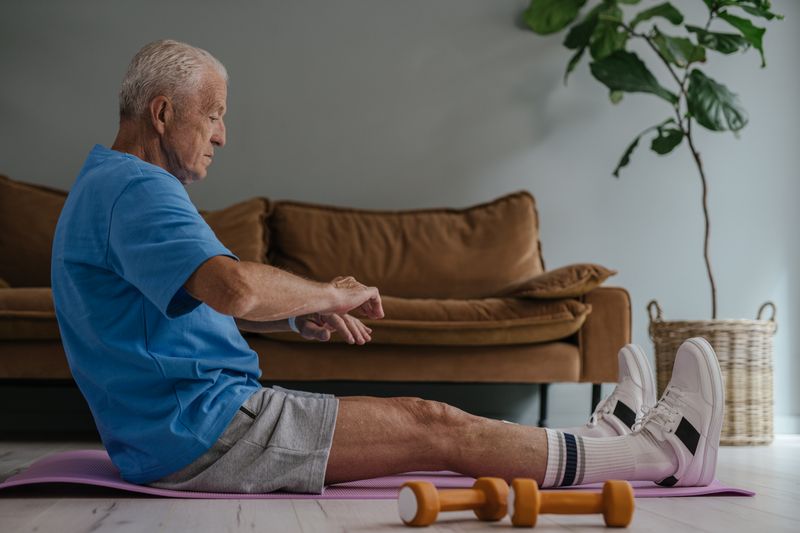
Low-Impact Home Workout Equipment: A Joint-Friendly Buying Guide
A joint-friendly buying guide to low-impact home workout equipment, comparing resistance bands, adjustable dumbbells, seated cardio and balance gear with US price ranges.
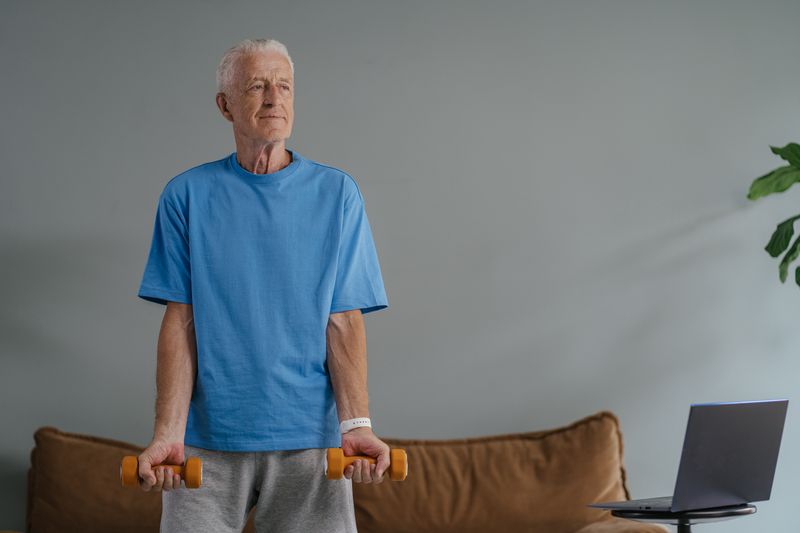
How to Start Exercising at Home After 50: A Practical Plan
A step-by-step home workout plan for adults over 50, covering the cheapest starter kit, joint-friendly warm-ups, four beginner exercises, and an eight-week progression.
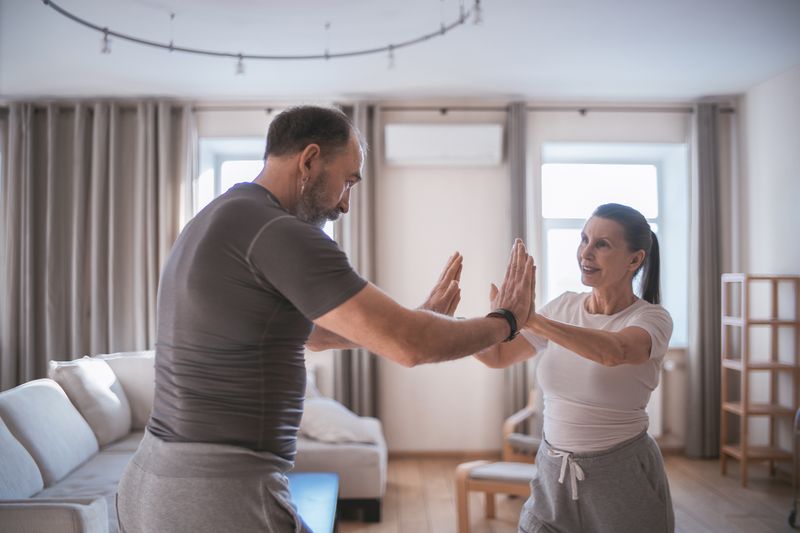
Home Gym for Seniors: The Complete Guide to Getting Started
A complete, practical guide to building a joint-friendly home gym after 50: what to buy in what order, the four pillars of older-adult fitness, a sample weekly routine, safety, and how to progress and stay consistent.
📖 All articles on Gym4Home →
Browse our other articles