Best Home Gym Equipment for Seniors Over 60: What Actually Works
This article may contain affiliate links. If you make a purchase through these links, we may earn a small commission at no extra cost to you. This helps us keep creating free content.

Hinweis: Dieser Artikel ersetzt keine ärztliche Beratung. Besprich Trainingsfragen im Zweifel mit Arzt oder Physiotherapie.
Health note: This article is for general information only and is not a substitute for medical advice. Talk to your doctor before starting a new exercise programme, especially if you have an existing health condition or injury.
A complete strength setup for someone over 60 costs roughly $150 to $400 (approximate retail), takes up less than a closet, and avoids almost every machine you see advertised. The equipment that matters at this age is light, adjustable, and forgiving on the joints. The chrome multi-station tower in the catalogue is not on the list, and neither is a treadmill.
After 60, muscle loss (sarcopenia) speeds up. Strength training is one of the few things shown to slow it, which is why the goal here is resistance you can scale finely, not heavy loads you have to grit through. Everything below is chosen for that: small jumps in difficulty, a stable base, and easy storage.
The list is built around how a real body over 60 moves. Grip can be weaker, balance needs a wall or chair nearby, and getting down to the floor and back up is itself a workout. Each pick is rated on those terms, not on how impressive it looks.
Keep one principle in mind as you read: the goal is to keep doing the basic things of daily life with ease, such as carrying groceries, climbing stairs, and getting up off a low chair, well into your seventies and eighties. Strength training is the most direct way to protect those abilities, and the right home equipment makes it something you can do on a Tuesday morning in your slippers rather than a trip you talk yourself out of. Everything below is chosen to lower the barrier to actually starting and to keep you progressing safely once you have.
What to prioritise at 60+ (and what to skip)
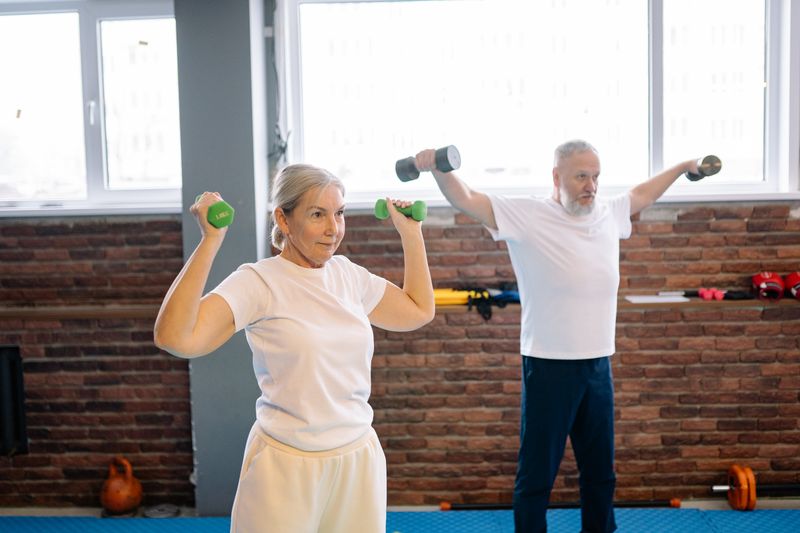
Three things decide whether equipment gets used or gathers dust: how finely you can adjust the resistance, how kind it is to your joints, and how little it asks of your balance. A loadable barbell fails the first test for most beginners because the smallest jump is often 5 pounds, which can be a 20% increase in one go. Adjustable dumbbells and bands win because they let you add a pound or a single band at a time.
Skip anything that locks you into one path of motion under load if you have cranky shoulders or knees, and skip equipment that needs you to be on the floor unless getting up is easy for you. The Smith machine, the leg-extension station, and the rowing erg all have their place, but they are not where a 60-year-old beginner should spend the first $300.
There is a fourth quality that gets ignored: how easy the equipment is to set up and put away. Gear that lives in a closet and takes ten minutes to deploy gets used twice and then forgotten. A band that hangs on a hook and a pair of dumbbells in the corner stay in the routine because the friction to start is near zero. At 60, the equipment that wins is the equipment that is already out and ready when you walk past it.
One more thing belongs on the skip list: anything sold mainly on its console, its app subscription, or its screen. The motor, the touchscreen and the monthly fee add cost and failure points without adding a single rep of strength. A $300 band-and-dumbbell setup outlasts a $2,000 connected machine and never needs a software update.
The core kit, compared
Fit Simplify Resistance Bands Set
Five resistance levels in a kit that fits in a drawer, gentle on the joints and ideal to start with.
As an Amazon Associate we earn from qualifying purchases.
Five items cover almost every exercise an older beginner needs. You do not need all five at once. The table ranks them by how much they give you per dollar and per square foot, with the gentlest options near the top.
| Equipment | Approx. US price | Joint-friendliness | Best for |
|---|---|---|---|
| Resistance band set (loop + handle) | $15–35 | Very high | Whole-body strength, low impact, finest adjustment |
| Adjustable dumbbells (5–25 lb pair) | $80–200 | High | Progressive loading without a rack of weights |
| Stability/balance items (mat, light kettlebell) | $25–60 | High | Core, posture, fall-prevention work |
| Sturdy bench or step | $40–120 | Medium-high | Seated pressing, step-ups, support |
| Doorway pull-up/assist bar | $25–40 | Medium | Grip, back strength with band assistance |
Resistance bands: the gentlest place to start
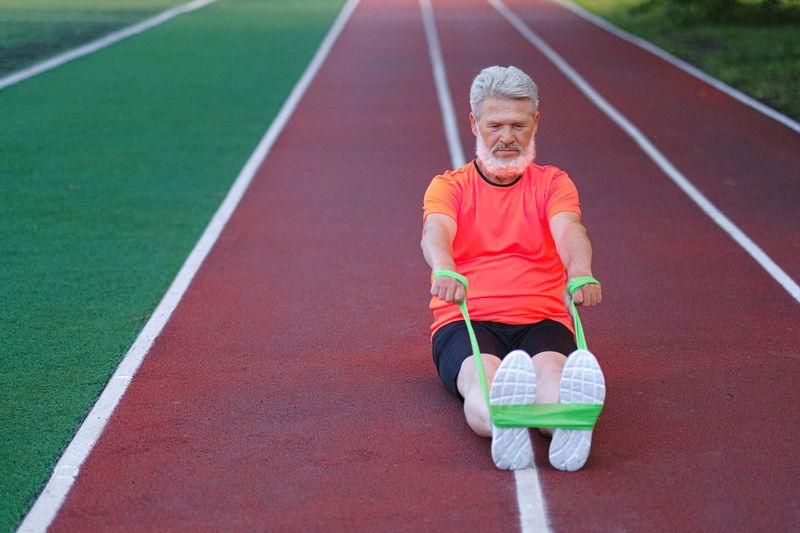
Bands deliver strength gains with almost no joint loading, and the resistance is easiest of all to dial in. A typical set of five loop bands runs $15 to $35 (approximate retail) and covers light to fairly heavy. Because the tension builds as you stretch the band rather than dropping on you like a weight, a shoulder or knee that flares under iron often tolerates bands well.
The downside is worth naming plainly: very strong people eventually outgrow even the heavy bands for legs. For most beginners over 60 that ceiling is months or years away, so bands are the better first buy than dumbbells. Pick fabric loop bands for hips and legs, and a tube set with handles for pressing and rowing.
Adjustable dumbbells: where to add load over time
Adjustable dumbbells replace a whole rack with one pair, which matters in a small home. A 5-to-25-pound adjustable pair costs roughly $80 to $200 (approximate retail), and the dial or pin lets you climb in small steps as you get stronger. That fine progression is exactly what ageing muscle responds to.
Two cautions apply at this age. Grip strength fades, so pick a model with a comfortable, not overly fat, handle and always work over a mat in case one slips. And start lighter than your ego suggests, because tendons and joints adapt more slowly than muscles do. Adding a pound a week beats jumping five and tweaking a shoulder.
There are two common designs. Dial-adjust dumbbells change weight by twisting a knob on the end, which is fast and convenient but uses more plastic and can feel bulky in the hand. Spin-lock or plate-loaded handles cost less and feel more solid, but you load plates by hand between sets, which is slower. For an older beginner who values quick changes and a clean grip, the dial type is usually worth the extra money, while a tight budget is well served by a basic plate-loaded pair.
Whatever you choose, the smallest available jump matters more than the top weight. A pair that climbs in 2.5-pound steps lets you progress sustainably for years. A pair whose smallest increment is 5 pounds forces jumps that are too big for ageing joints once you reach the middle of its range, which is exactly where you will spend most of your time.
Balance, core and a bench
Fall prevention is strength training that happens to look like balance work. A non-slip mat plus one light kettlebell (5 to 15 pounds, about $25 to $60 approximate retail) covers carries, gentle swings to a comfortable height, and core holds that steady the trunk. Strong hips and a stable core are what keep a stumble from becoming a fall.
A bench or sturdy step ($40 to $120 approximate retail) earns its space by making seated and supported moves possible. Seated presses take the balance demand out of the equation so you can focus on the muscle, and step-ups train the exact pattern you use on stairs. If money is tight, a solid chair and the bottom step of your staircase stand in for both.
When you do buy a bench, look for a flat or flat-incline model with a wide, stable base and a low enough seat that your feet sit flat on the floor. A wobbly bench is worse than no bench at all, because instability is the one thing you are trying to remove. Skip the folding decline benches and the ones with leg-curl attachments; for an older lifter they add bulk and pinch points without adding useful exercises.
A sensible first kit by budget
On about $50, buy a good band set and a non-slip mat. That alone runs a full-body programme for months. On about $150, add an adjustable dumbbell pair in the 5-to-25-pound range. On about $350, add a bench and a light kettlebell, and you have a setup that will carry you for years without a single machine.
Buy in that order rather than all at once. It spreads the cost, and more importantly it lets your joints adapt to one new stimulus at a time instead of five.
One accessory deserves a mention before the table: a non-slip mat is cheap insurance, not an optional extra. It steadies dumbbells that might roll, gives your feet grip during standing band work, and cushions the spot where you do floor or kneeling moves. At $20 to $40 (approximate retail) it removes a real slip risk for very little money, which is why it sits in the very first $50 of the plan.
What you will notice missing from every tier is a cardio machine, a leg-press, and anything motorised. That is deliberate. The fastest path to feeling stronger, steadier on your feet, and more capable on stairs at this age is resistance you can progress in small steps, done two or three times a week. Walking covers your cardio outdoors for free. Spend the equipment budget on the strength tools above, and add a machine later only if a specific need appears.
| Budget | What to buy | What it unlocks |
|---|---|---|
| ~$50 | Band set + mat | Full-body strength, lowest impact |
| ~$150 | Add adjustable dumbbells | Progressive loading for years |
| ~$350 | Add bench + light kettlebell | Seated work, carries, balance, step-ups |
Frequently asked questions
Is strength training safe to start at 65 or 70? Many people begin in their 60s and 70s and do well, but the safe answer for you depends on your health history. Clear it with your doctor first, then start light and progress slowly. The risk usually comes from doing too much too soon, not from training itself.
How often should an older beginner train? Two or three short sessions a week, with a rest day between, suits most people. Muscle is built during recovery, and older tissue recovers a little slower, so more is not better in the early weeks.
Do I need a treadmill or cardio machine too? Not to start. Brisk walking covers cardio for most people over 60 at no cost and with no storage footprint. Add a machine only if weather or mobility makes walking impractical.
What about machines with a fixed path, like a leg-press? They can be useful once you have a base, because they remove the balance demand. They are a poor first purchase though: expensive, bulky, and they let you load weight your joints are not ready for. Bands and dumbbells first.
How much space does this really need? A band set, a pair of dumbbells, a mat and a chair fit in a corner of one room. The whole kit above stores in less space than a bicycle.
Will bands alone build real muscle at my age? For a beginner, yes, bands provide enough resistance to drive strength gains for a good while. The day you can do many reps with the heaviest band easily is the day to add dumbbells, not before.
I have arthritis in my hands. What helps? Many people with hand or wrist arthritis find loop bands and bands with padded handles easier to hold than a bare metal dumbbell. Lifting straps that wrap around the handle can also take pressure off the grip, and a kettlebell's thicker handle suits some hands better than a thin bar. Ask your doctor or a physio what your joints can tolerate, then test grips before you buy.
Should I buy new or used? Dumbbells, kettlebells and benches are excellent used buys because cast iron and steel do not wear out, and you can often find them at half retail. Buy bands new, since old latex degrades and can snap. Check used dumbbell mechanisms work smoothly and a used bench is rock solid before you hand over cash.
How long until I notice a difference? Many beginners feel steadier and a little stronger within three to four weeks of consistent training, with visible changes taking longer. The early gains come largely from your nervous system learning the movements, which is why progress can feel quick at first. Keep showing up two or three times a week and the results compound over months.
What if I can only spend $50 total? Buy a five-band loop set and a non-slip mat, and use a chair you already own. That covers squats, presses, rows, hinges and core for months. Add weight only once the heaviest band stops challenging you, which for most beginners is a good way down the road.
🛠️ Free tools for this topic
No sign-up. They do the calculating and checking for you.
Published by the Gym4Home editorial team. Published June 29, 2026. Updated October 4, 2026.
Editorial responsibility: see Imprint.
Spotted an error or have something to add? corrections@gym4home.com
Home Gym Tips, Weekly
Equipment picks, workout ideas, and setup guides — for every space and every budget. No fluff, just useful.
🎁 Free bonus: The Home Gym Starter Checklist (PDF)
You might also like
Used Gym Equipment Buying Guide: What to Buy and What to Skip
A buying guide to used gym equipment: which gear is a safe secondhand buy, what to skip, how to inspect it, and what to pay.
Best Adjustable Dumbbells for Older Adults: A Practical Buying Guide
A practical guide to choosing adjustable dumbbells for older adults, comparing dial and pin systems, weight ranges and grip-friendly features with US prices.
How to Build a Home Gym After 60 on a Budget
A practical, budget shopping list and starter routine for building a joint-friendly home gym after 60, with US prices and where to spend versus save.
📖 All articles on Gym4Home →
Browse our other articles