Resistance Bands vs Dumbbells: Which Belongs in Your Home Gym
This article may contain affiliate links. If you make a purchase through these links, we may earn a small commission at no extra cost to you. This helps us keep creating free content.
Resistance bands win on cost, storage and joint-friendliness; dumbbells win on raw strength building and ease of progression. For most people setting up a first home gym in limited space, the right answer is not one or the other but bands first, then dumbbells added later. The two tools load your muscles differently, and that difference decides which one suits a given exercise.
A dumbbell loads you with constant gravity: the weight is the same at the bottom and top of a curl. A band loads you with variable tension that climbs as you stretch it, so it is lightest where the muscle is weak and hardest where the muscle is strong. Neither pattern is better in the abstract. They match different exercises and different bodies.
Cost and storage compared
A full set of quality resistance bands costs $25 to $60 and fits in a drawer or hangs on a single hook. That set typically covers a range from about 10 to 150 pounds of equivalent resistance by stacking bands, which would cost hundreds of dollars and fill a rack in dumbbells. For an apartment, the space saving alone is decisive.

Dumbbells are expensive per pound and bulky. A fixed set spanning useful weights runs $1.50 to $2.50 per pound, so a modest 5 to 50 lb range is a few hundred dollars and needs a rack. Adjustable dumbbells from Bowflex, NordicTrack or PowerBlock compress that into two handles for roughly $300 to $450 a pair, which is the space-efficient route but a real upfront cost.
| Factor | Resistance bands | Dumbbells |
|---|---|---|
| Starter cost | $25–60 full set | $300–450 adjustable pair |
| Storage | A drawer or hook | A rack or floor space |
| Joint impact | Very low, smooth tension | Higher at lockout |
| Progression | Coarse, by band swap | Fine, by small jumps |
| Best for | Rehab, travel, pulling | Strength, pressing, squats |
| Durability | Wears out in 1–3 years | Effectively forever |
How each one builds strength
PowerBlock Elite EXP Adjustable Dumbbells
One pair replaces a whole rack and stores in the space of a shoebox.
As an Amazon Associate we earn from qualifying purchases.
Dumbbells build maximum strength more directly because the load is constant and easy to increase in small, measurable steps. Adding 5 lb to a press is a clear progression your nervous system and muscles respond to. This linear, trackable overload is why barbell and dumbbell work remains the backbone of strength programs.
Bands build strength too, but the curve works against the heaviest part of some lifts. A banded squat is hardest at the top, where your legs are strongest, and easiest at the bottom, where they are weakest. That makes bands excellent for muscles and movements where the strong point is the stretched position, such as the back during rows and pull-aparts, and less ideal for pressing and squatting where you want load in the bottom range.
Joint friendliness and the over-50 angle
Bands are easier on cranky joints because the tension eases off at the end range where dumbbells peak. At the top of a dumbbell press your elbow locks under full load; with a band the load has already done most of its work lower down and the lockout is light. For shoulders, elbows and knees that complain about heavy lockouts, this matters.
Bands also have no momentum and no dead weight to catch if you fail a rep, which removes the small risk of dropping a dumbbell on a foot or losing control overhead. For someone training alone at home without a spotter, that safety margin is a clear advantage. Dumbbells demand a bit more attention to control, especially as the weight climbs.
What bands do better
Bands are unbeatable for travel, rehab and pulling movements. They weigh a few ounces and fit in a carry-on, so your training survives any trip. Physical therapists reach for them first because the smooth, controllable tension lets you load a recovering joint without the jarring of free weights. And for the entire pulling chain of rows, pull-aparts and pulldowns, the strength curve lines up beautifully.
They also let you train movements that are hard to load with dumbbells at home, such as standing chest flyes, lateral walks for the hips, and assisted pull-ups using a band looped over a bar. None of those need an anchor heavier than a door, which keeps the whole setup apartment-friendly.
What dumbbells do better
Dumbbells own pressing, squatting, lunging and any lift where you want the heaviest load in the stretched, bottom position. A dumbbell goblet squat or a floor press loads the muscle exactly where bands go slack. They also make precise progression trivial, which keeps long-term strength gains coming once you are past the beginner stage.
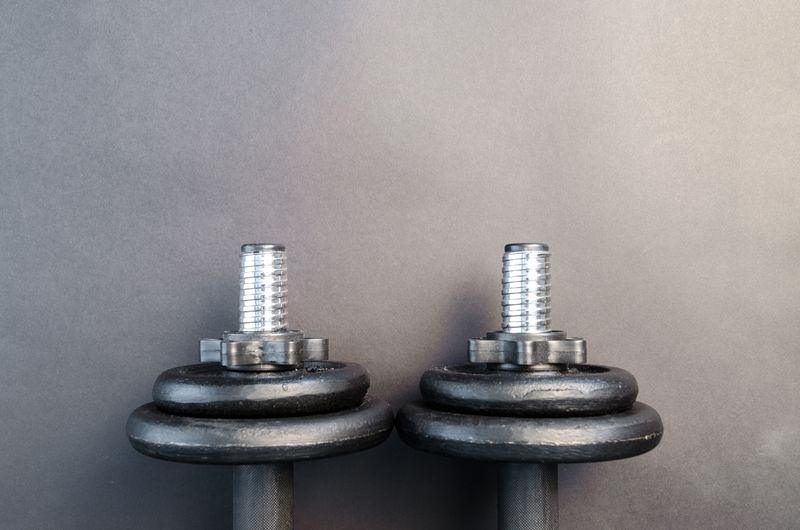
For pure muscle and strength building past the first six months, dumbbells pull ahead because you can keep nudging the weight up in small, consistent steps. Bands force coarse jumps: the next band up might add 30 pounds of resistance, which is a big leap on a small exercise. That granularity gap is the main reason serious strength work drifts toward iron over time.
The verdict for a home gym
Buy bands first if you are starting out, short on space, working around joint issues, or training on a tight budget. A $40 band set plus a doorway anchor gives you a full-body workout immediately, and you can decide later whether you want more. For most apartment dwellers over 50, that is the smart entry point. Bands also let you train the same day you buy them with no rack, no bench and no neighbours to worry about, which removes most of the excuses that stall a home gym before it starts.
Add an adjustable dumbbell pair once you want serious pressing and squatting strength and you have confirmed you will keep training. The strongest home gym is not bands versus dumbbells at all; it is bands for pulling and rehab plus a pair of adjustable dumbbells for pressing and legs. If you must pick only one to begin, bands give more capability per dollar and per square foot. A reasonable two-step plan is a band set now, then a dial-adjustable dumbbell pair in a few months once you know you will keep training, which spreads the cost and proves the habit before you spend the larger sum. That sequence wastes nothing, because the bands stay useful for pulling and warm-ups long after the dumbbells arrive.
How to combine both in one workout
The best home sessions use each tool where it shines rather than forcing one to do everything. Press and squat with dumbbells, where you want load at the bottom of the movement. Row, pull and do rear-shoulder work with bands, where the tension climbs into the strong range and spares the joint. A single full-body workout might be dumbbell goblet squats, dumbbell floor presses, band rows, band pull-aparts and dumbbell Romanian deadlifts.
You can also stack the two on the same exercise for a custom resistance curve. Looping a light band over the handles of a dumbbell press adds tension at lockout, which loads the top of the movement that dumbbells alone leave easy. This is an advanced trick rather than a starting point, but it shows why owning both beats owning either alone once you progress.
A practical weekly split for someone who owns both is two dumbbell-led days and one band-led day. The dumbbell days build pressing and leg strength with goblet squats, floor presses and lunges. The band day focuses on the upper back, rear shoulders and hips with rows, pull-aparts and lateral walks, giving the joints a lower-load session that still moves real resistance. This rotation keeps the pressing volume from overloading shoulders that are already busy at a desk all day.
The most common band mistake is buying a single thin tube set with fixed plastic handles. When one tube wears out the whole unit is scrap, and the handles often tear free under load. A modular set with a carabiner clip system lets you swap individual bands and replace a worn one for a few dollars. Flat loop bands and tube-with-handle bands serve different jobs, so a good starter set includes both styles. The most common dumbbell mistake is the mirror image: buying spin-lock adjustable dumbbells with screw collars that loosen mid-set, rattle, and can let a plate slide off during an overhead press, a real hazard at home with no spotter. Dial or pin-selector adjustable dumbbells lock positively and change in seconds, which is worth the higher price for safety and convenience in a tight space.
🛠️ Free tools for this topic
No sign-up. They do the calculating and checking for you.
Published by the Gym4Home editorial team. Published September 3, 2026. Updated October 4, 2026.
Editorial responsibility: see Imprint.
Spotted an error or have something to add? corrections@gym4home.com
Home Gym Tips, Weekly
Equipment picks, workout ideas, and setup guides — for every space and every budget. No fluff, just useful.
🎁 Free bonus: The Home Gym Starter Checklist (PDF)
You might also like
Adjustable vs Fixed Dumbbells: Which Belongs in Your Home Gym?
A full comparison of adjustable and fixed dumbbells for home gyms, covering cost per pound, footprint, durability and joint-friendly details, with concrete model picks.
Resistance Bands: Loop vs Tube, Which Should You Buy?
Loop vs tube resistance bands compared by use, grip, durability, and price, with a clear recommendation on which to buy first for a home gym.
Best Resistance Bands for a Home Gym in 2026
The three resistance band types compared, with US prices, sizing without printed pounds, durability traps, and a complete band workout.
📖 All articles on Gym4Home →
Browse our other articles