No-Equipment Bodyweight Workout for Seniors
This article may contain affiliate links. If you make a purchase through these links, we may earn a small commission at no extra cost to you. This helps us keep creating free content.
Health note: This article is for general information only and is not a substitute for medical advice. Talk to your doctor before starting a new exercise programme, especially if you have an existing health condition or injury.
Bodyweight training builds usable strength for older adults without a single piece of equipment or any impact on the joints. The exercises below use a chair, a wall, and the floor, which means you can do them in a living room and stop the moment anything feels wrong. The goal is not to look like a bodybuilder. It is to keep the everyday strength that lets you climb stairs, carry groceries, and get up off the floor on your own.
Strength naturally declines with age, but that decline is far from fixed. Many people in their sixties, seventies, and beyond regain noticeable strength within a few weeks of regular training. The movements here are scaled so a beginner can start gently and make them harder as they get stronger, all without weights.

Why bodyweight training suits older adults
Your own bodyweight is a built-in resistance that adjusts to you. A sit-to-stand from a chair loads your legs with exactly the weight you carry every day, which is the load that matters for real life. There is no equipment to buy, store, or learn, and nothing to drop on your foot.
Bodyweight work is also low-impact when chosen well. Standing and seated exercises keep both feet planted and spare the knees and hips the pounding of running or jumping. That makes this style of training a sensible fit for people managing arthritis, easing back into activity after a quiet few years, or simply wary of getting hurt. Always work within a comfortable range and never push through sharp pain.
Warm up first, every time
Retrospec Solana Thick Exercise Mat (1/2 in)
A thick, non-slip mat makes floor work and stretching comfortable on the joints.
* Affiliate link. We may earn a commission at no extra cost to you.
Five minutes of gentle movement prepares your muscles and joints and lowers the chance of a strain. March in place while seated or standing, roll your shoulders backward, and circle your ankles in both directions. Add a few slow arm raises overhead to wake up the upper body.
Move at a pace where you can still hold a conversation. The warm-up should leave you feeling looser and slightly warmer, not winded. If you feel dizzy at any point, sit down and rest. There is no prize for rushing this part.
The workout: six foundational exercises
Run through these in order, two or three times a week, with a rest day between sessions. Start with one set of each and build to two or three sets over a few weeks as you get stronger. The reps below are a starting guide. Do fewer if a set feels hard and that is completely fine.
| Exercise | Sets | Reps | How to do it |
|---|---|---|---|
| Sit-to-stand | 2–3 | 8–12 | From a chair, stand up without using your hands, sit back down slowly |
| Wall push-up | 2–3 | 8–12 | Hands on wall, lean in bending elbows, press back to standing |
| Standing march | 2–3 | 10–16 | Hold a counter, lift one knee then the other, tall posture |
| Heel raise | 2–3 | 10–15 | Hold support, rise onto the balls of your feet, lower slowly |
| Seated knee extension | 2–3 | 10–12 each | Sit tall, straighten one leg out, hold a second, lower |
| Standing side leg raise | 2–3 | 8–12 each | Hold support, lift one leg out to the side, keep the torso still |
The sit-to-stand is the most valuable movement here because it mirrors something you do dozens of times a day. If standing without hands is too hard at first, use your hands lightly and aim to need them less over time. If it is easy, slow the lowering phase to four seconds, which makes the muscles work harder with no extra weight.
Wall push-ups train the chest, shoulders, and arms at an angle that takes pressure off the wrists and shoulders. The farther your feet are from the wall, the harder the exercise becomes, so you have a built-in dial for difficulty. Keep your body in a straight line from head to heels and lower under control.
Balance work that may help prevent falls
Balance is a skill that responds to practice, and keeping it strong is one of the most worthwhile things an older adult can train. Many people find that a few minutes of daily balance work makes them steadier on stairs and uneven ground. Always do these beside a counter or sturdy chair you can grab.
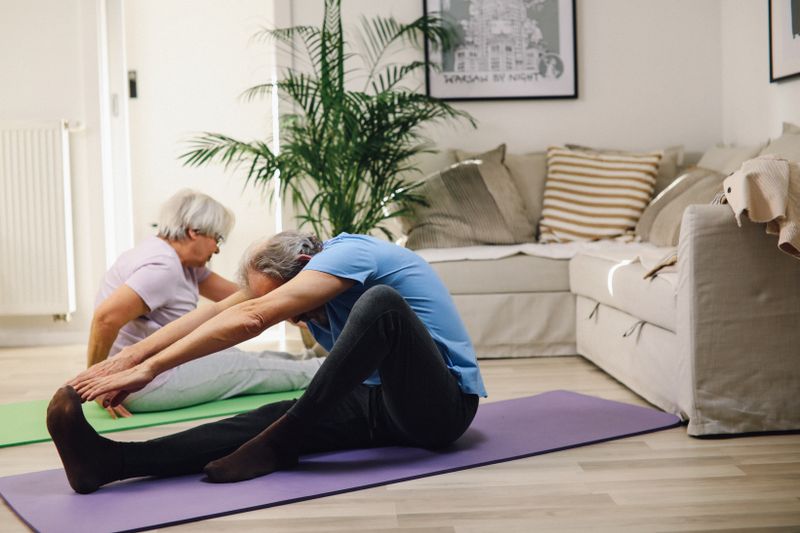
Start with a simple single-leg stand: hold support, lift one foot an inch off the floor, and hold for 10–20 seconds, then switch. As you improve, try touching the support with just one finger, then hovering your hand near it. The tandem stand (one foot directly in front of the other, heel to toe) is a slightly harder progression to add once the single-leg stand feels secure.
How to progress safely over the weeks
Add difficulty gradually so your body keeps adapting without getting overloaded. The simplest progression is to add a set: go from one round of the circuit to two, then to three, over four to six weeks. After that, add a rep or two per exercise before making any movement harder.
You can also slow the tempo. Taking three to four seconds to lower into each sit-to-stand or heel raise increases the time your muscles work, which builds strength without any equipment or added joint stress. This is often the gentlest way to keep getting stronger when reps start to feel easy.
Listen to your body across the week, not just within a session. A little fatigue and mild soreness a day later are normal signs of training. Lingering tiredness, aching joints, or trouble sleeping suggest you are doing too much too soon, so take an extra rest day. Steady, patient progress beats heroic weeks that lead to a strain.
Making the habit stick beyond the workout
Strength training works best when it sits alongside an active daily life rather than replacing it. A daily walk, even ten or fifteen minutes, supports your heart, your mood, and the recovery between sessions. Standing up and moving once an hour through the day keeps joints loose and reinforces the very strength you are building. The workout is the structured part, but the small movements between sessions matter just as much for staying capable.
Anchor the routine to something you already do so it becomes automatic. Many people find that pairing the exercises with a fixed cue, such as after breakfast or before an evening programme, makes them far easier to keep up than a vague plan to train sometime that day. Laying out a chair and clearing a small space in advance removes the friction that quietly ends most new habits in the first month.
If you manage a condition like arthritis or are easing back after a quiet spell, gentle and regular beats hard and occasional. Three short sessions a week, done consistently for months, build far more lasting strength than an ambitious week followed by a sore retreat. Track your sessions on a simple calendar and let the run of ticked days carry you forward. Progress in this kind of training is measured in months, and the people who keep going are the ones who win.
Frequently asked questions
How often should an older adult do this workout? Two or three sessions a week with a rest day between them suits most people. That frequency gives muscles time to recover and adapt while keeping the habit regular. On off days, a gentle walk is a fine complement.
Is it normal to feel sore after starting? Mild muscle soreness a day or two after a new routine is common and usually eases within a few days as your body adjusts. Sharp or joint pain is different and is a reason to back off and, if it persists, to check with your doctor.
What if I can only manage a few reps? A few good reps is a perfect starting point. Strength builds from where you are now, not from where a chart says you should be. Do what you can with control, rest, and add a rep when it feels manageable. Progress over weeks is what counts.
Do I need any equipment at all? No. A sturdy chair, a clear bit of wall, and a counter to hold for balance cover everything here. If you later want a little more challenge, light resistance bands are inexpensive and joint-friendly, but they are entirely optional.
🛠️ Free tools for this topic
No sign-up. They do the calculating and checking for you.
Published by the Gym4Home editorial team. Published October 1, 2026.
Editorial responsibility: see Imprint.
Spotted an error or have something to add? corrections@gym4home.com
Home Gym Tips, Weekly
Equipment picks, workout ideas, and setup guides — for every space and every budget. No fluff, just useful.
🎁 Free bonus: The Home Gym Starter Checklist (PDF)
You might also like
A 4-Week Bodyweight Workout Plan for Total Beginners
A four-week, no-equipment bodyweight plan with sets and reps that ramps from total beginner to harder variations in five simple movements.
Chair Exercises for Seniors: A Full Seated Strength Workout at Home
A full seated strength workout for older adults using one sturdy chair. Seven exercises with sets and reps, a warm-up, a cool-down and progression tips.
Seated Resistance Band Workout for Seniors: 8 Exercises You Can Do in a Chair
A safe, joint-friendly seated resistance band routine for older adults: eight chair exercises with sets, reps and clear setup instructions.
📖 All articles on Gym4Home →
Browse our other articles