Chair Exercises for Seniors: A Full Seated Strength Workout at Home
This article may contain affiliate links. If you make a purchase through these links, we may earn a small commission at no extra cost to you. This helps us keep creating free content.
Health note: This article is for general information only and is not a substitute for medical advice. Talk to your doctor before starting a new exercise programme, especially if you have an existing health condition or injury.
A sturdy dining chair is all you need to train the legs, arms, back and core in one 20-minute session. Seated and chair-supported exercises let older adults work every major muscle group while a stable base takes balance out of the equation, which many people find makes strength training far less intimidating to start.
The workout below uses one chair without arms, a small space, and your own body weight. Add light resistance bands or a pair of 1 to 3 pound weights once the moves feel comfortable. Pick a chair that does not roll, sit tall with both feet flat on the floor, and stop any movement that causes sharp pain.
Warm up first (3 to 5 minutes)
Cold muscles work less and strain more, so spend a few minutes loosening up before the main moves. Sit tall and march your feet in place for one minute, lifting each knee gently. Then roll your shoulders backward 10 times and forward 10 times to open the upper back.
Finish the warm-up with seated torso turns. Place your hands lightly on your thighs and rotate your upper body slowly to the left, then the right, 8 times each side. Keep the movement smooth and within a comfortable range. You should feel warmer and looser, not breathless.
The seated strength workout
Retrospec Solana Thick Exercise Mat (1/2 in)
A thick, non-slip mat makes floor work and stretching comfortable on the joints.
As an Amazon Associate we earn from qualifying purchases.
Move through the exercises in order, resting 30 to 60 seconds between each. Do one full round if you are new to this, building toward two rounds over a few weeks. The sets and reps below are a starting point; reduce them if you are tired and never push into pain.
| # | Exercise | Sets | Reps | Works |
|---|---|---|---|---|
| 1 | Sit-to-stand | 2 | 8–10 | Legs, glutes |
| 2 | Seated knee extension | 2 | 10 each leg | Thighs |
| 3 | Seated marching | 2 | 20 total | Hips, core |
| 4 | Seated row (band) | 2 | 10–12 | Upper back |
| 5 | Overhead reach | 2 | 10 | Shoulders |
| 6 | Seated calf raise | 2 | 15 | Calves |
| 7 | Seated knee lift (core) | 2 | 10 each leg | Lower abs |
How to do each exercise
1. Sit-to-stand. Sit toward the front of the chair, feet flat and hip-width apart. Lean slightly forward, press through your heels and stand up fully, then lower back down with control. Use your hands on the seat for help at first, and progress to no hands. This is the single most useful move for keeping everyday independence.
2. Seated knee extension. Sit tall and straighten one leg until it is roughly level with your hip, hold for a second, then lower slowly. Alternate legs. Add an ankle weight later for more challenge.
3. Seated marching. Lift one knee toward your chest, lower it, then the other, as if marching in your seat. Keep your back straight and let your core do the work rather than leaning back.
4. Seated row with a band. Loop a resistance band around both feet and hold an end in each hand. Sit tall and pull your elbows back, squeezing your shoulder blades together, then release slowly. No band? Mimic the motion with a firm squeeze at the back. This strengthens the muscles that hold you upright.
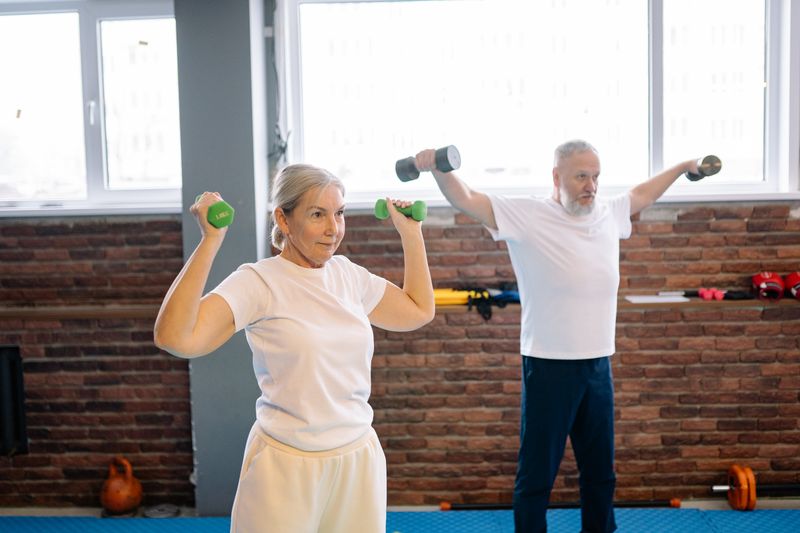
5. Overhead reach. With or without light weights, raise both arms overhead, reaching tall without shrugging your shoulders to your ears, then lower. Keep the movement slow on the way down.
6. Seated calf raise. Feet flat, press up onto the balls of your feet to lift your heels, hold briefly, then lower. This supports ankle strength, which many people find helps with steadier walking.
7. Seated knee lift for the core. Hold the sides of the chair, sit tall and lift one knee a few inches while bracing your stomach, then lower with control. Alternate legs. Keep breathing throughout.
Cool down and stretch
Spend three minutes letting your heart rate settle and easing the muscles you worked. Stretch the front of each thigh by holding the chair, standing if steady, and gently bending one knee to bring the heel back. Hold each stretch for 20 to 30 seconds without bouncing.
Finish with a seated hamstring stretch: extend one leg with the heel on the floor, sit tall, and hinge forward from the hips until you feel a gentle pull behind the thigh. Breathe slowly. Stretching while the muscles are warm helps maintain the range of motion you use for dressing, bending and getting in and out of a car.
How often and how to progress
Two to three sessions a week, on non-consecutive days, gives your muscles time to recover and rebuild. Many older adults see steadier standing and easier stair climbing within a few weeks of consistent seated training. Consistency beats intensity here; a short workout done regularly outperforms a long one done rarely.
Progress by adding the second round, then by adding light resistance: a band, a 1 to 3 pound weight, or an ankle weight that runs about $10 to $25 for a pair (approximate retail). When an exercise feels easy at the listed reps, add 2 to 3 reps before adding weight. Keep the chair nearby for any standing variations so support is always within reach.
Common mistakes to avoid
Slouching cancels out much of the benefit. When the back rounds and the shoulders fall forward, the working muscles get a holiday and the joints take the strain. Sit toward the front of the seat, stack your ears over your shoulders, and keep both feet planted. If you cannot hold the posture, do fewer reps with good form rather than more reps while collapsing.
Rushing is the other frequent error. Momentum, not muscle, does the work when you snap through a movement, and the control phase on the way down is where much of the strength is built. Count two seconds up and two to three seconds down on every rep. Holding your breath is a related habit to break: exhale on the effort, breathe in on the return, and never bear down.
Frequently asked questions
Can chair exercises really build strength? Yes. Working a muscle against resistance, including body weight and bands, signals it to get stronger at any age. The chair removes balance worries so you can focus that effort safely.
What if I can only do a few reps? Start with whatever number feels manageable, even three or four, and build slowly. The body adapts to gradual increases, and starting small is how lasting progress begins.
Do I need any equipment? No. The whole routine works with body weight and a sturdy chair. A resistance band and light weights are optional upgrades for when the moves feel comfortable.
How often should I do this workout? Two to three times a week on non-consecutive days works well, leaving a rest day between sessions for the muscles to recover. On in-between days, a short walk or the gentle warm-up moves on their own keep you moving without overloading the same muscles.
Is it normal to feel sore afterwards? A mild, general soreness in the muscles a day or two later is normal when you are new to strength work and tends to fade as the body adapts. Sharp pain, joint pain or swelling is not normal; ease off and check with your doctor if it persists.
Can I do these exercises if I use a walker or have balance problems? The seated exercises are well suited to people with balance concerns, since the chair provides a stable base throughout. Skip any standing variations unless someone is nearby, and ask your doctor or a physiotherapist which moves fit your situation.
🛠️ Free tools for this topic
No sign-up. They do the calculating and checking for you.
Published by the Gym4Home editorial team. Published August 11, 2026. Updated October 4, 2026.
Editorial responsibility: see Imprint.
Spotted an error or have something to add? corrections@gym4home.com
Home Gym Tips, Weekly
Equipment picks, workout ideas, and setup guides — for every space and every budget. No fluff, just useful.
🎁 Free bonus: The Home Gym Starter Checklist (PDF)
You might also like
Seated Resistance Band Workout for Seniors: 8 Exercises You Can Do in a Chair
A safe, joint-friendly seated resistance band routine for older adults: eight chair exercises with sets, reps and clear setup instructions.
A 30-Minute Dumbbell Workout for Seniors (Full-Body, Joint-Friendly)
A complete 30-minute full-body dumbbell workout for older adults, with a sets-and-reps table, step-by-step form for seven exercises, and safe progression tips.
Resistance Bands for Seniors: Beginner Workout Plan (No Gym Needed)
A complete beginner resistance-band program for older adults: why bands suit aging joints, how to choose and anchor them safely, and a full four-week plan covering upper body, legs, core and balance.
📖 All articles on Gym4Home →
Browse our other articles