How to Set Home Gym Goals You'll Actually Stick To
This article may contain affiliate links. If you make a purchase through these links, we may earn a small commission at no extra cost to you. This helps us keep creating free content.

Hinweis: Dieser Artikel ersetzt keine ärztliche Beratung. Besprich Trainingsfragen im Zweifel mit Arzt oder Physiotherapie.
Most home gyms gather dust within three months because the owner never set a goal more specific than "get in shape". Vague goals give you nothing to plan around and no way to tell whether today's session counts, so motivation leaks away. A goal you can actually train toward names a number, a deadline, and a reason that survives a bad week.
Setting goals well is a skill, and it is the one that separates the home gym that becomes a habit from the one that becomes a clothes rack. The framework below works whether you are 35 or 65, and it is built around the realities of training alone at home, where nobody else holds you accountable.
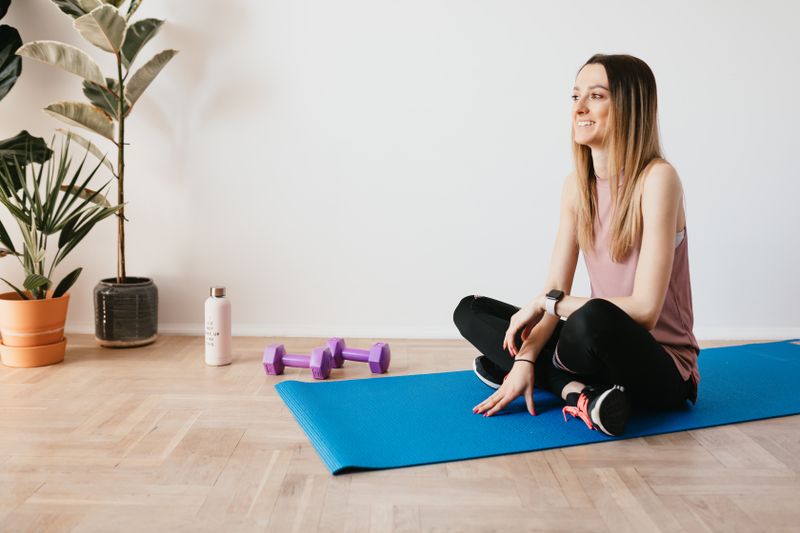
Why "get fit" fails and a real goal doesn't
A goal has to be measurable or you cannot steer toward it. "Get fit" has no finish line and no scoreboard, so every session feels optional and progress feels invisible. The brain needs feedback, and a measurable goal supplies it: you either did ten push-ups today or you did eight last month, and that gap is something to chase.
Measurable also keeps you accountable. When the goal is fuzzy, it is easy to claim you are doing fine while quietly skipping sessions. A concrete target ends the negotiation. Either the squat weight went up this month or it did not, and the number does not care how you feel about it.
Outcome goals versus process goals
Fit Simplify Resistance Bands Set
Five resistance levels in a kit that fits in a drawer, gentle on the joints and ideal to start with.
As an Amazon Associate we earn from qualifying purchases.
There are two kinds of goal, and you need both. An outcome goal is the destination, such as losing 15 pounds or doing your first full push-up. A process goal is the daily behavior that gets you there, such as training four times a week or hitting your protein at lunch. Outcome goals motivate; process goals are what you actually control.
The trap is chasing only outcomes. You cannot directly make the scale move on a given Tuesday, which makes outcome goals frustrating in the short term. You can directly choose to train and to eat well today, so judge yourself on the process and let the outcome follow. People who track behaviors stick around far longer than people who only track results.
| Type | Example | You control it? |
|---|---|---|
| Outcome goal | Lose 15 lb in 4 months | Indirectly |
| Process goal | Train 4x a week | Directly |
| Outcome goal | Do 1 full push-up | Indirectly |
| Process goal | Practice push-ups 3x a week | Directly |
Make it specific, measurable, and time-bound
A workable goal answers three questions: what exactly, how much, and by when. "Get stronger" becomes "add 20 pounds to my goblet squat by the end of March". "Do more cardio" becomes "walk 8,000 steps a day, five days a week". The specificity is what lets you build a plan and check progress against it.
The deadline matters as much as the number. An open-ended goal has no urgency, so it slides forever. A 12-week window is long enough to make real change and short enough that this week's session feels like it counts. When the 12 weeks end, you measure, celebrate or adjust, and set the next one.
Set the bar where you'll clear it
Ambition feels good on day one and crushes you by week three. A goal pitched too high, like training six days a week when you have never trained at all, sets up failure, and one failed week often ends the whole project. Pick a target you are about 80% sure you can hit, then let success build the appetite for more.
Starting small is not lack of ambition, it is strategy. Two sessions a week that you actually complete beat five planned sessions you abandon by Wednesday. Once two weeks is a locked-in habit, adding a third is easy because the foundation is already there. Momentum compounds, and the first job is simply to build some.

Build the goal into a plan and a schedule
A goal without a schedule is a wish. The moment you set the target, decide which days and times you will train and write them into your calendar like any other appointment. "I will train when I have time" reliably becomes never, because the time never volunteers itself. "Monday, Wednesday, Friday at 7am" actually happens.
Reverse-engineer the plan from the goal. If the goal is your first push-up in 12 weeks, the plan is progressing from wall push-ups to incline push-ups to knee push-ups over those weeks. If the goal is a 20-pound squat increase, the plan is adding a small amount of weight every week or two. Each session should obviously serve the goal, or it does not belong in the week.
Track, review, and adjust without quitting
What gets written down gets done. Keep the simplest possible log: a note on your phone or a cheap notebook where you jot the date, what you did, and the weights or reps. The log turns invisible progress visible, and on a low-motivation day, flipping back to where you started three months ago is often the push you need.
Review the goal every few weeks, not every day. Daily checking invites obsession over normal ups and downs. A fortnightly look at your log tells you whether the trend is going the right way, and if it has stalled for three weeks, that is the signal to change something: more food, more rest, or a different exercise. Adjusting is not failing.
When you hit a goal, mark it before you sprint to the next one. Acknowledging a win, even a small one, is what makes the next 12 weeks feel worth starting. The home gym becomes permanent not through one heroic burst of motivation but through a stack of completed goals, each one quietly proving to you that you are the kind of person who follows through.
Staying on track when motivation runs out
Motivation is unreliable fuel, and every long-term home gym owner trains plenty of days without it. The goal-setting framework above is partly insurance against this exact problem: when you do not feel like training, the scheduled appointment and the visible streak in your log carry you where willpower cannot. You show up because it is Wednesday at 7am and that is what you do, not because you feel inspired.
Shrink the session on low days rather than skipping it. A rule that has saved countless habits is the two-minute version: on a day you would otherwise quit, commit to just the warm-up and one set. Most days, once you have started, you finish the whole thing. On the rare day you do stop after two minutes, you still kept the streak alive, and the streak is the asset worth protecting.
A goal set in January may not fit your life in March, and that is normal. A busy work stretch, an illness, or a family event can make a four-day plan impossible for a few weeks, and the right move is to scale the goal down temporarily rather than abandon it. Two short maintenance sessions a week hold most of your progress, and dropping to them beats dropping out entirely.
Treat a missed week as data, not defeat. If you keep missing the same Thursday session, the schedule is wrong, not your character, so move it to a day that actually works. The people who train for years are not the ones with perfect discipline. They are the ones who keep adjusting the plan until it fits the life they actually have, then quietly come back after every interruption.
How many goals should I have at once? One primary goal per 12-week block, with at most one secondary goal in the background. More than that splits your focus and almost guarantees you make slow progress on all of them instead of real progress on one.
What if I miss my deadline? Missing a deadline is feedback, not failure. Look at why: was the goal too ambitious, the schedule unrealistic, or did life intervene? Adjust the target or the timeline and set a new deadline. The 12-week clock is a tool to create urgency, not a test you pass or fail.
Should my goal be about weight or strength? For most people over 50, a strength or capability goal beats a scale goal, because it keeps you focused on building something rather than shrinking. Strength goals also tend to produce the body changes people actually want, while a scale obsession can push you toward losing muscle along with fat.
🛠️ Free tools for this topic
No sign-up. They do the calculating and checking for you.
Published by the Gym4Home editorial team. Published July 2, 2026. Updated October 4, 2026.
Editorial responsibility: see Imprint.
Spotted an error or have something to add? corrections@gym4home.com
Home Gym Tips, Weekly
Equipment picks, workout ideas, and setup guides — for every space and every budget. No fluff, just useful.
🎁 Free bonus: The Home Gym Starter Checklist (PDF)
You might also like
Soreness After a Workout: What Is Normal and What Isn't
How to tell normal post-workout muscle soreness (DOMS) from a real warning sign, plus what actually helps you recover.
How to Start a Home Gym From Scratch (Step-by-Step for Beginners)
A step-by-step beginner guide to building a home gym from scratch: space, the five items to buy first, noise fixes, a starter routine, and smart upgrades.

Foam Roller Guide: Types, Density and How to Use One
A practical foam roller guide covering density, length and texture, how to pick your first roller, and a step-by-step routine for the main muscle groups.
📖 All articles on Gym4Home →
Browse our other articles