Your First Month of Home Gym Workouts: A Week-by-Week Plan
This article may contain affiliate links. If you make a purchase through these links, we may earn a small commission at no extra cost to you. This helps us keep creating free content.
Hinweis: Dieser Artikel ersetzt keine ärztliche Beratung. Besprich Trainingsfragen im Zweifel mit Arzt oder Physiotherapie.
Three full-body sessions a week, 30 to 40 minutes each, builds more strength in your first month than daily random workouts ever will. The body adapts to stress during rest, not during the lift, so a beginner who trains three times a week and recovers properly outpaces someone grinding every day with no plan. The whole point of the first month is to teach your body the movement patterns, wake up the muscles, and build the habit before you add load.
You do not need a rack of dumbbells or a power cage to start. A pair of adjustable dumbbells, a flat bench or sturdy chair, and a resistance band cover every pattern a beginner needs. If you have only your bodyweight, that works too for the first few weeks. The plan below assumes minimal equipment and a small space, roughly the footprint of a yoga mat plus room to swing your arms.
How the first month is structured
The plan runs on a three-day split: Monday, Wednesday, Friday, with rest or light walking on the days between. That spacing gives each muscle group around 48 hours to recover, which is what beginners need to grow and avoid the deep soreness that makes people quit in week one. If your schedule fits Tuesday, Thursday, Saturday better, that is fine. The exact days matter far less than keeping a full day of rest between sessions.
Each session is full-body, hitting a push movement, a pull movement, a squat or hinge for the legs, and a core exercise. Full-body beats a split routine for beginners because you practise each pattern three times a week instead of once, and skipping a single day costs you less. Over four weeks you keep the same exercises and add small amounts of weight or reps, so your body learns the movements deeply before you complicate things.
Warm up for five minutes before every session: arm circles, bodyweight squats, hip swings, and a minute of marching in place. Cool down with a couple of easy stretches for the muscles you worked. Skipping the warm-up is the fastest route to a tweaked shoulder or a sore lower back in your first two weeks.
The week-by-week progression
Fit Simplify Resistance Bands Set
Five resistance levels in a kit that fits in a drawer, gentle on the joints and ideal to start with.
As an Amazon Associate we earn from qualifying purchases.
The table below shows how the same routine scales across the month. Week one is about learning form with light or no weight. Each following week you nudge the difficulty up: more reps, then more sets, then more weight. This is progressive overload in its gentlest form, and it is why month one builds a foundation instead of just making you tired.
| Week | Focus | Sets x reps per exercise | Rest between sets |
|---|---|---|---|
| Week 1 | Learn form, light load | 2 x 10 | 90 sec |
| Week 2 | Add reps | 2 x 12 | 75 sec |
| Week 3 | Add a set | 3 x 10 | 75 sec |
| Week 4 | Add weight, drop reps slightly | 3 x 8 heavier | 60 sec |
Notice the load does not jump every week. In weeks one and two you keep the weight the same and simply do more reps, which builds the control you need before going heavier. Only in week four do you reach for the next dumbbell setting, and when you do, you drop the rep target so the heavier weight stays manageable. If a jump in weight wrecks your form, go back down. Clean reps beat heavy sloppy ones every time at this stage.
The five exercises you actually do
Every session uses the same five movements. Keeping the list short means you get good at them fast and you can measure progress clearly. Here is what each one is and how to perform it.
- Goblet squat: Hold one dumbbell against your chest with both hands. Stand with feet shoulder-width apart, push your hips back, and lower until your thighs are roughly parallel to the floor. Drive up through your heels. This trains your legs and core at once and is gentler on the knees than a barbell back squat.
- Dumbbell floor press or push-up: Lie on a bench or the floor, press two dumbbells from chest height to straight arms. If you have no bench, do push-ups against the floor or, if those are too hard, against a wall or kitchen counter. This is your push movement for chest, shoulders, and triceps.
- Bent-over dumbbell row: Hinge forward at the hips with a slight knee bend, back flat, and pull two dumbbells toward your ribs. Squeeze your shoulder blades together at the top. This is your pull movement and balances out all the pressing.
- Romanian deadlift: Hold dumbbells in front of your thighs, keep a soft bend in the knees, and push your hips back as you lower the weights down your legs. Feel the stretch in your hamstrings, then stand tall. This builds the back of your legs and your lower back safely when done slow.
- Plank: Hold a straight line from head to heels on your forearms and toes. Brace your stomach as if bracing for a punch. Start with 20 seconds and add time each week. This is your core work and it carries over to every other lift.
What recovery and food look like in month one
Sleep does more for your first-month results than any supplement. Muscle repairs and grows while you sleep, so seven to nine hours a night turns your three weekly sessions into actual progress. If you cut sleep short, you carry fatigue into the next workout and your numbers stall. Treat rest as part of the programme, not as time off from it.
Protein is the one food lever worth pulling early. Aim for a palm-sized portion of protein at each meal: eggs, chicken, fish, yogurt, beans, or a scoop of whey if whole food is hard to hit. You do not need to track every calorie in month one. Eating enough protein and not skipping meals covers the basics while you build the training habit.
Expect some muscle soreness in the first two weeks, especially a day or two after each session. That dull ache is normal and fades as your body adapts. Sharp or joint pain is different and means you should stop that exercise and check your form or reduce the load. Soreness in the muscle belly is fine. Pain in a joint is a signal to back off.
Fitting the sessions around a busy life
Thirty to forty minutes three times a week is the realistic floor for results, and it fits into most schedules if you treat it like an appointment. Block the time in your calendar the same way you would a meeting, and put the equipment somewhere you see it, because a bench tucked behind a closet door tends to stay there. Consistency predicts month-one success far better than the perfect programme does. Turning up on the days you planned is what moves the numbers.
If a session gets squeezed, shorten it rather than skipping it. A 20-minute version doing two sets instead of three of each exercise still keeps the habit alive and still stimulates your muscles. A skipped day breaks the rhythm and makes the next one easier to skip too. On weeks when life is chaotic, aim to protect at least two of the three sessions, since two real workouts beat one perfect one you keep postponing.
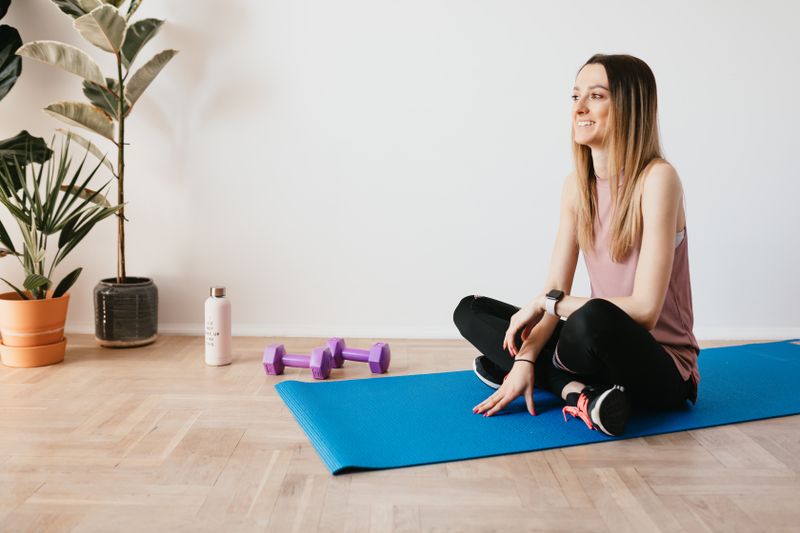
Set up your space so starting takes under a minute. Dumbbells out, mat down, water bottle filled, a short playlist ready. Every bit of friction between you and the first rep is a chance to talk yourself out of it. Beginners who remove that friction train far more consistently than those who have to dig equipment out of a cupboard before every session.
How to know it is working
By the end of week four you should be lifting more weight or doing more reps than you did in week one on at least three of the five exercises. That measurable jump is the proof your plan worked, even if the mirror has not changed much yet. Visible muscle takes longer, but strength gains in month one come fast because your nervous system gets better at recruiting muscle before the muscle itself grows.
Keep a simple log: date, exercise, weight, sets, and reps. A note in your phone is enough. The log removes guesswork, shows you exactly when to add weight, and gives you a record to look back on when motivation dips in week three, which is when most beginners quit. Seeing the numbers climb is what carries you into month two.
When month one ends and every exercise feels controlled, you are ready to add a fourth weekly session or split the body into upper and lower days. But there is no rush. Plenty of people stay on a solid three-day full-body plan for six months and keep progressing the whole time. The foundation you build now is the thing every later result stands on.
🛠️ Free tools for this topic
No sign-up. They do the calculating and checking for you.
Published by the Gym4Home editorial team. Published July 21, 2026. Updated October 4, 2026.
Editorial responsibility: see Imprint.
Spotted an error or have something to add? corrections@gym4home.com
Home Gym Tips, Weekly
Equipment picks, workout ideas, and setup guides — for every space and every budget. No fluff, just useful.
🎁 Free bonus: The Home Gym Starter Checklist (PDF)
You might also like
Soreness After a Workout: What Is Normal and What Isn't
How to tell normal post-workout muscle soreness (DOMS) from a real warning sign, plus what actually helps you recover.
Home Gym Equipment: What to Buy First (and What to Skip)
A step-by-step buying order for home gym equipment, starting with adjustable dumbbells and a bench, with price ranges and the pieces most people buy too early.
Beginner Strength Workout: A Simple 3-Day Home Plan
A beginner-friendly 3-day full-body strength plan for home, with complete sets and reps using only a pair of dumbbells.
📖 All articles on Gym4Home →
Browse our other articles