Home Workout Warm-Up and Cool-Down: A Practical Routine
This article may contain affiliate links. If you make a purchase through these links, we may earn a small commission at no extra cost to you. This helps us keep creating free content.

Hinweis: Dieser Artikel ersetzt keine ärztliche Beratung. Besprich Trainingsfragen im Zweifel mit Arzt oder Physiotherapie.
A five-minute warm-up raises your muscle temperature by about one to two degrees Celsius, which makes tissue more pliable and lowers the chance of a strain during your first heavy set. Skipping it at home is tempting because the equipment is right there and nobody is watching, but cold muscles tear more easily and your first reps feel stiff and weak. The warm-up and cool-down are the bookends that let the actual workout do its job safely.
At home you have no group class to follow and no coach reminding you, so the routine has to be simple enough that you actually do it every session. The good news: a proper warm-up needs zero equipment and a cool-down needs only a mat and a wall. What follows is a repeatable structure you can run before and after any strength or cardio session in a spare room, garage, or apartment corner.

Why warming up matters more at home
Home workouts often start cold in a literal sense. A garage in winter or an air-conditioned spare room keeps your body temperature low, and you frequently roll out of a chair or out of bed straight into training. Your joints have been static, your hips are tight from sitting, and your nervous system is not yet primed to fire muscles hard. Going from that state into a loaded squat or a set of push-ups asks a lot of cold tissue.
The warm-up does three jobs. It increases blood flow to the working muscles, it takes your joints through their full range of motion so the movement pattern feels familiar, and it wakes up the nervous system so you recruit more muscle fibres on your working sets. People who train at 50 and beyond notice the difference fastest, because connective tissue loses some elasticity with age and needs a little longer to get ready.
The general warm-up: five minutes, no equipment
Retrospec Solana Thick Exercise Mat (1/2 in)
A thick, non-slip mat makes floor work and stretching comfortable on the joints.
As an Amazon Associate we earn from qualifying purchases.
Start with light full-body movement to get your heart rate up and your blood moving. The aim is a light sweat and slightly quicker breathing, not fatigue. You should finish the general warm-up feeling looser and warmer, with plenty left in the tank for the real work.
Run through the sequence below at an easy pace. Each move flows into the next, so the whole block takes about five minutes. If a movement bothers a knee or shoulder, shrink the range until it feels clean rather than skipping it entirely.
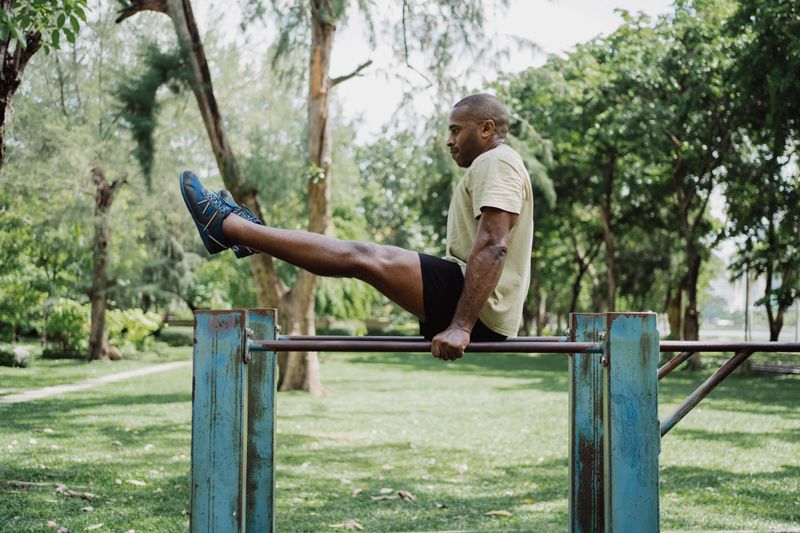
- Marching or jogging on the spot (60 seconds): lift the knees to a comfortable height and let the arms swing. This raises your core temperature.
- Arm circles (30 seconds): big slow circles forward, then backward. This opens the shoulders.
- Leg swings (30 seconds each leg): hold a wall, swing one leg front to back, then side to side. This loosens the hips.
- Bodyweight squats (10 reps): sit back and down to a comfortable depth, no load. This grooves the squat pattern.
- Hip circles and torso twists (60 seconds): hands on hips, draw circles with the pelvis, then rotate the upper body gently left and right.
- Walkouts to plank (5 reps): hinge down, walk the hands out to a plank, hold a breath, walk back. This warms the core and shoulders together.
The specific warm-up: prime the day's lifts
After the general warm-up, do a lighter version of the first exercise in your session. This is the part most home lifters skip, and it is the part that protects you most on heavy sets. If your first working move is a goblet squat with a 20 kg dumbbell, do a set with just bodyweight, then a set with a 5 kg or 10 kg weight before you load up.
Specific warm-up sets do something general movement cannot: they rehearse the exact pattern, groove your dumbbell path, and let your nervous system calibrate the effort. Two ramp-up sets are usually enough for a home session. Keep the reps moderate and the rest short, since the goal is preparation rather than fatigue.
| Working set load | Warm-up set 1 | Warm-up set 2 |
|---|---|---|
| Bodyweight only | Slow tempo, partial range | Full range, controlled |
| Light dumbbells (5–10 kg) | Bodyweight, 8 reps | Half the load, 6 reps |
| Heavier dumbbells / barbell | ~40% load, 8 reps | ~60% load, 4 reps |
Cool-down: bring the heart rate down deliberately
Stopping dead after a hard set leaves blood pooled in your working muscles and your heart rate elevated, which can leave you light-headed. A two to three minute cool-down of easy movement lets your heart rate drift back toward resting and starts the recovery process. Walk around the room, march slowly, or pedal an easy minute on a bike if you have one.

This is also the moment your circulation is still high and your tissue is warm, which makes it the best window for the longer stretches you skipped earlier. The cool-down does not erase next-day soreness, despite the common claim, but it does help you transition out of training mode and it keeps your range of motion in check over the weeks.
A static stretch sequence for after training
Hold each stretch for 20 to 30 seconds and breathe slowly. Aim for mild tension, never pain. Run through whichever stretches match the muscles you trained, and don't feel obliged to do all of them every session. Five focused stretches beat fifteen rushed ones.
- Standing quad stretch: hold a wall, pull one heel toward your glute, knees together.
- Doorway chest stretch: forearm on the frame, step gently through to open the chest after pushing work.
- Seated hamstring stretch: one leg out, hinge from the hip toward the toes, back flat.
- Figure-four glute stretch: lying on your back, ankle across the opposite knee, draw the thigh in.
- Child's pose: kneel and reach forward to lengthen the lower back and lats.
- Calf stretch on a wall: back leg straight, heel down, lean into the wall.
Adjusting for joints, age, and small spaces
If you train past 50 or carry an old knee or shoulder issue, lengthen the warm-up rather than the workout. Add a minute of marching, do three ramp-up sets instead of two, and pay attention to the joint that usually complains. Many people find that a slightly longer warm-up removes the first-set ache that used to feel like a problem.
Space is rarely the limiter here, which is the beauty of it. The whole warm-up and cool-down fits in a square metre, needs no equipment beyond a mat and a wall, and makes no noise that would bother a neighbour below you. If your ceiling is low, swap arm circles for cross-body arm swings and keep the marching flat-footed. The routine flexes to the room you actually have.
Cardio sessions need a different warm-up
A cardio warm-up leans on the same engine you are about to use rather than on loaded patterns. Before a run, a bike interval session, or a rower workout, spend the first three to five minutes at an easy pace in that exact activity, then build gradually toward your working intensity. Cold legs sent straight into a hard interval are how calf and hamstring strains happen, so the gradual ramp matters as much here as it does under a barbell.
The cool-down after cardio is where most home trainees cut corners, and it is the one that affects how you feel afterward. Easing from a hard effort down to a walk over two or three minutes lets your heart rate fall in a controlled way and helps clear the by-products of hard work from your legs. Follow it with calf, hip-flexor, and hamstring stretches, since those are the muscles that tighten most from running and cycling.
Putting it into one repeatable session
The full structure is short enough to memorise: five minutes of general movement, two ramp-up sets of your first lift, your working sets, then two to three minutes of easy movement and a handful of stretches. That envelope adds roughly ten to twelve minutes to a session and pays for itself in fewer tweaks and better working sets.
Consistency beats perfection. A simple warm-up you do every single time protects you far more than an elaborate mobility routine you do twice and abandon. Build the habit around the equipment you already train with, keep it boring and repeatable, and let it run on autopilot so the real workout gets your attention.
🛠️ Free tools for this topic
No sign-up. They do the calculating and checking for you.
Published by the Gym4Home editorial team. Published July 9, 2026. Updated October 4, 2026.
Editorial responsibility: see Imprint.
Spotted an error or have something to add? corrections@gym4home.com
Home Gym Tips, Weekly
Equipment picks, workout ideas, and setup guides — for every space and every budget. No fluff, just useful.
🎁 Free bonus: The Home Gym Starter Checklist (PDF)
You might also like
A Home Core Workout With No Crunches (and Why That's Better)
A no-crunch core circuit you can do at home in 20 minutes, built on planks and carries that train real spinal stability.

How Many Sets and Reps Should You Do in a Home Gym?
How many sets and reps to do at home for strength, muscle, or endurance, with rest times, loading tips, and a sample beginner week.
Leg Day at Home With No Machines: A Complete Routine
A complete leg workout you can do at home with no machines, using dumbbells and bodyweight. Sets-and-reps table, form cues and progression.
📖 All articles on Gym4Home →
Browse our other articles