Apartment Workout With Resistance Bands: No Floor Space Needed
This article may contain affiliate links. If you make a purchase through these links, we may earn a small commission at no extra cost to you. This helps us keep creating free content.

Resistance bands let you train your whole body standing in a two-foot square, with no weights to drop and no noise to annoy the neighbour below. A single set of loop and tube bands costs about $15 to $35 (approximate retail) and stores in a drawer. That makes them the most apartment-friendly strength tool there is.
The workout below uses a doorway as your anchor and your own footing as the base. Nothing here requires lying on the floor for more than a moment, nothing thuds, and the whole session takes 25 to 35 minutes. You progress by using a heavier band or slowing the lowering phase, not by clearing more space.
Set up by looping a tube band's anchor on the hinge side of a closed door, at chest height for presses and rows. Keep one heavier and one lighter band within reach so you can switch without resetting. Work in a slow, controlled tempo: two seconds to lift, three seconds to lower. Clear a small mat-sized space, make sure nothing fragile sits within arm's reach, and keep water nearby so you do not break the flow once you start.
Why bands suit apartments specifically
Bands solve the three problems that wreck most apartment workouts. There is no impact noise, so no thump travels through the floor. There is no dropped iron, so nothing dents a rented floor or wakes a baby. And the footprint is tiny, because the resistance lives in the band rather than in a stack of plates that needs a corner.
The tension profile helps too. A band gets harder the more you stretch it, so the hardest point is at full contraction where your joint is most stable. For pressing and rowing in a tight space, that feels controlled rather than jerky.
Storage seals the case. A full band set, anchor strap and handles weigh under two pounds and live in a drawer or on a single hook by the door. There is no rack to assemble, no plates to find a home for, and nothing a guest will trip over. In a rented apartment where you cannot drill or bolt anything down, that matters as much as the workout itself.
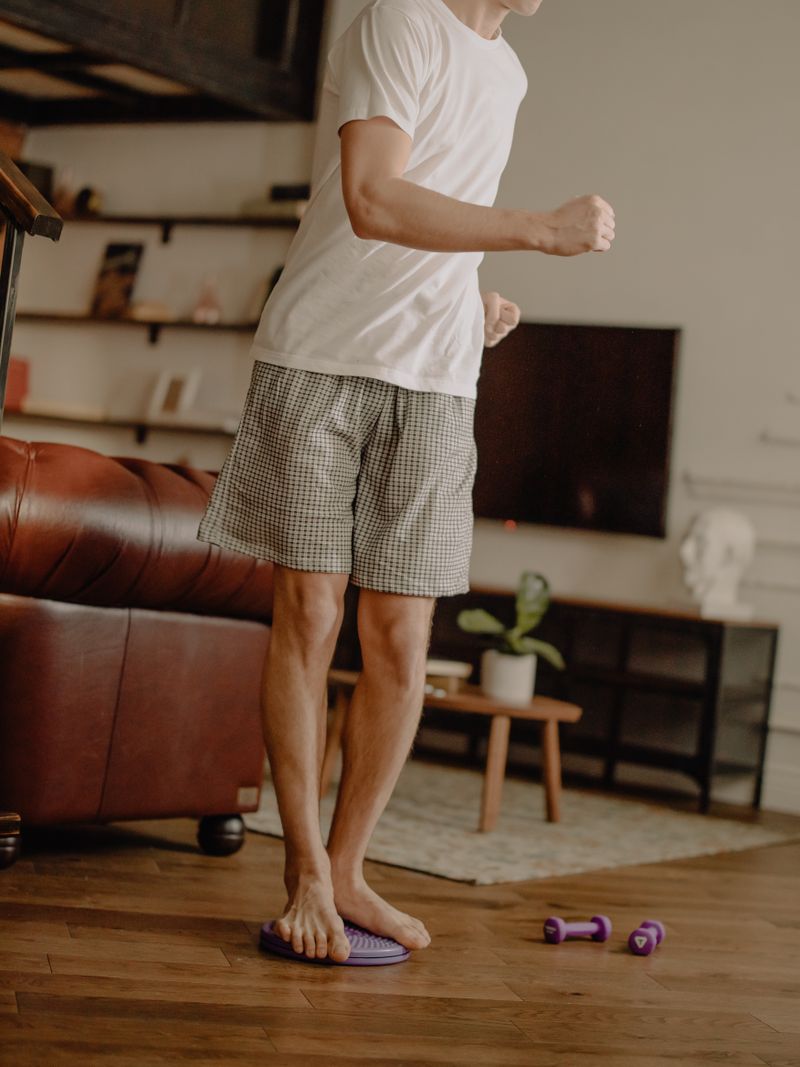
You will also save your downstairs neighbour. The most common complaint in apartment buildings is impact noise travelling through the floor, and bands produce none of it. No weight ever leaves your hands to hit the ground, so you can train early in the morning or late at night without a single thud reaching the unit below.
The full-body session
Fit Simplify Resistance Bands Set
Five resistance levels in a kit that fits in a drawer, gentle on the joints.
As an Amazon Associate we earn from qualifying purchases.
Seven exercises cover the whole body: push, pull, hinge, squat, and core. Do them as a circuit, resting 30 to 45 seconds between moves, then repeat the circuit twice more for three rounds total. The table gives sets, reps and the tempo to hold.
| Exercise | Sets x reps | How to do it |
|---|---|---|
| Banded squat | 3 x 12–15 | Stand on the band, hold the handles at your shoulders, squat to a comfortable depth. |
| Chest press (door anchor) | 3 x 10–12 | Anchor mid-height behind you, press the handles forward to full arm length. |
| Seated/standing row | 3 x 12 | Anchor in front at chest height, pull elbows back, squeeze the shoulder blades. |
| Overhead press | 3 x 10 | Stand on the band, press the handles from shoulders to overhead. |
| Romanian deadlift | 3 x 12 | Stand on the band, hinge at the hips with a flat back, feel the hamstrings. |
| Banded pull-apart | 3 x 15 | Hold a band at chest width, pull it apart to your chest, control the return. |
| Pallof press (anti-rotation core) | 3 x 10/side | Anchor at the side, press the handle straight out, resist the twist. |
Getting harder without more room
Progression in an apartment never means a bigger footprint. Switch to a thicker band when 15 reps feels easy, which is the cheapest jump. Slow the lowering phase to four or five seconds to multiply the work without touching the resistance. Or pause for two seconds at the hardest point of each rep, which exposes weak ranges fast.
Double up bands for the strongest movements, your squat and row, by standing on two loops at once. That stacks tension cleanly without adding any equipment that needs storing. Most people find one mid set plus one heavy band covers a year of progress.
A 20-minute short version
On a tight day, drop to four moves done as two rounds: banded squat, chest press, row, and Pallof press. That hits legs, push, pull and core in under 20 minutes and still leaves you worked. Keep the same tempo so the shorter session stays hard enough to count.
Two or three sessions a week builds noticeable strength for a beginner. Bands recover you fast because the load is gentle on joints, so back-to-back days are fine if you alternate which moves you push hardest.
To make the short version count, pick a band heavy enough that the last two or three reps of each set are a struggle. The temptation with a quick session is to coast through on a light band, which trains very little. Pushing close to failure on four hard moves beats drifting through seven easy ones every time you are short on minutes.
What to buy and how to anchor it
A complete set runs $15 to $35 (approximate retail) and should include a range of resistances, a door anchor, and detachable handles. Loop bands (flat fabric or latex) suit hips, squats and pull-aparts, while tube bands with handles suit pressing and rowing. Buying the two styles together covers every move in this workout without gaps.
The door anchor is the part that turns one band into a cable machine, so do not skip it. Feed the foam-covered nub through the gap on the hinge side of a closed door, then shut the door to trap it. Switch the anchor to the top of the door for pull-downs, the middle for presses and rows, and the bottom for curls and leg work. A second anchor point, such as a sturdy hook or a leg of a heavy bed, gives you more angles if your doors are flimsy.
Common mistakes that waste the workout
The biggest error is letting the band snap back. Lowering fast wastes the most productive half of every rep, since controlled lengthening under tension is where much of the strength comes from. Fight the band on the way down every time.
The second mistake is standing too close to the anchor, which leaves the band slack at the start. Step out until there is light tension before you begin, so the muscle works through the whole range. The third is gripping handles in a death grip, which tires your forearms before the target muscle, so relax the grip and let the bigger muscles drive.
A common setup error is anchoring at the wrong height, which changes the muscle worked. Press from a chest-height anchor for the chest, but anchor low for a curl and high for a pull-down. If a movement feels awkward or hits the wrong spot, the anchor height is usually the culprit, so adjust it before blaming the exercise itself.
A fourth error is using a band that is far too light just because it feels easy. Bands are cheap to upgrade, so there is no reason to spin your wheels on a resistance you cannot make hard. If a set of 15 leaves you fresh, the band is too light for that move and you should size up or double it. Effort, not equipment, is what builds the strength here.
- Don't let the band recoil. Three-second lowering on every rep.
- Start with light tension already on. Step away from the anchor before the first rep.
- Loosen your grip. Let legs, back and chest do the work, not your hands.
🛠️ Free tools for this topic
No sign-up. They do the calculating and checking for you.
Published by the Gym4Home editorial team. Published September 8, 2026. Updated October 4, 2026.
Editorial responsibility: see Imprint.
Spotted an error or have something to add? corrections@gym4home.com
Home Gym Tips, Weekly
Equipment picks, workout ideas, and setup guides — for every space and every budget. No fluff, just useful.
🎁 Free bonus: The Home Gym Starter Checklist (PDF)
You might also like
A Quiet 20-Minute Apartment Gym Morning Routine
A 20-minute quiet strength circuit you can do at 6am in an apartment without waking the neighbors below. Full routine and how to do each move.
Jumping Rope in an Apartment Without Annoying the Neighbors
Jump rope in an apartment without complaints. Why impact noise travels through the floor, how to build a quiet stacked surface, and the technique that keeps you silent.
Foldable Rowing Machines for Apartments: Picks and Trade-Offs
Folding magnetic rowers store in 2 square feet and stay quiet for downstairs neighbors. How resistance type affects noise, what specs to check, and picks by budget.
📖 All articles on Gym4Home →
Browse our other articles