Pull-Up Bar Alternatives for a Low Ceiling
This article may contain affiliate links. If you make a purchase through these links, we may earn a small commission at no extra cost to you. This helps us keep creating free content.

A standard doorway pull-up bar needs about 6 to 8 inches of clearance above the door frame and enough headroom for your body to hang fully. In a basement, a converted attic, or a room with 7-foot ceilings, that clearance often is not there. The good news is that several alternatives train your back and biceps just as well in cramped vertical space, and some need no overhead room at all.
The exercise you actually want is a vertical or horizontal pull, the movement pull-ups deliver. There are several ways to get that pull without a tall ceiling. The right one depends on whether your problem is overhead height, a frame you cannot mount to, or a rental where drilling is off the table.
Measure your real clearance first
Stand under the spot where a bar would go and reach up. A hanging pull-up needs your arms fully extended overhead plus space for your head to clear the bar at the top of the rep. For most adults that means a bar height of around 7 feet, with your body hanging below it. If your ceiling is 7 feet flat, a standard high-mounted bar simply will not fit. A doorway bar mounted in the frame sits lower and sometimes works where a ceiling mount cannot.
Hand height matters too. Measure from the floor to your raised knuckles. If that number plus the bar's mounting height exceeds your ceiling, you need an alternative that pulls horizontally or uses a band instead of a hang.
| Alternative | Overhead room needed | Rough US price | Mounts to |
|---|---|---|---|
| Doorway bar (low position) | Moderate | $25–35 | Door frame, no drilling |
| Resistance band pulldown | Minimal | $25–40 | Anchor point, low or high |
| Inverted row (bar/rings under table) | None | $0–40 | Sturdy table, low bar |
| Dumbbell rows | None | $200+ (DBs) | Floor, no mount |
| Free-standing low rack with chin bar | High | $150–300 | Free-standing |
The strongest no-ceiling option: inverted rows
Iron Gym Doorway Pull-Up Bar
Fits most door frames with no screws, for pull-ups and hanging.
As an Amazon Associate we earn from qualifying purchases.
The inverted row trains your back through the same pulling pattern as a pull-up while you stay nearly horizontal, so it needs zero overhead clearance. Set a bar in a low rack at hip height, or use a sturdy table edge, and lie underneath it. Grab the bar, keep your body straight from heels to shoulders, and pull your chest up to the bar. Lower under control.
Difficulty scales with body angle. The more horizontal you are, the harder it gets. Beginners keep their feet on the floor with the body at a steep angle, then walk the feet out flat as they get stronger. Rings or a suspension trainer looped over a low anchor work the same way and let you adjust angle instantly. This is the closest you get to a pull-up with a 7-foot ceiling.
Resistance band pulldowns
A resistance band anchored above a door recreates the lat pulldown machine for $25 to $40. Loop the band over the top of a door using a door anchor, kneel or sit below it, and pull the band down to your chest while keeping your torso still. The band stretches more as you pull, so the hardest part of the rep is the bottom, which matches where your back muscles work hardest.
If even an overhead anchor is too high, anchor the band low and do a seated row instead, pulling toward your stomach. Bands are joint-friendly, which suits older lifters or anyone managing shoulder issues, because there is no body weight loading the joint the way a dead hang does. They also store in a drawer and cost almost nothing.
Dumbbell rows for pure back work
If you already own dumbbells, the single-arm row covers your back with no mounting and no overhead space. Place one knee and one hand on a bench, let the dumbbell hang from your free hand, and pull it up toward your hip while keeping your back flat. It isolates one side at a time, which helps even out strength differences between your left and right.
Dumbbell rows will not build the exact grip and lat strength a hanging pull-up does, but for general back development in a low-ceiling room they are excellent and need nothing you do not already have. Pair them with band pulldowns to hit the vertical pulling angle the row misses, and your back is fully covered.
Which one to choose
For a 7-foot ceiling with no mounting options, go with a suspension trainer plus a band set. Together they cost under $170, store in a drawer, and cover every pulling angle without a single inch of overhead clearance. That combination beats trying to force a pull-up bar into a space that cannot fit one.
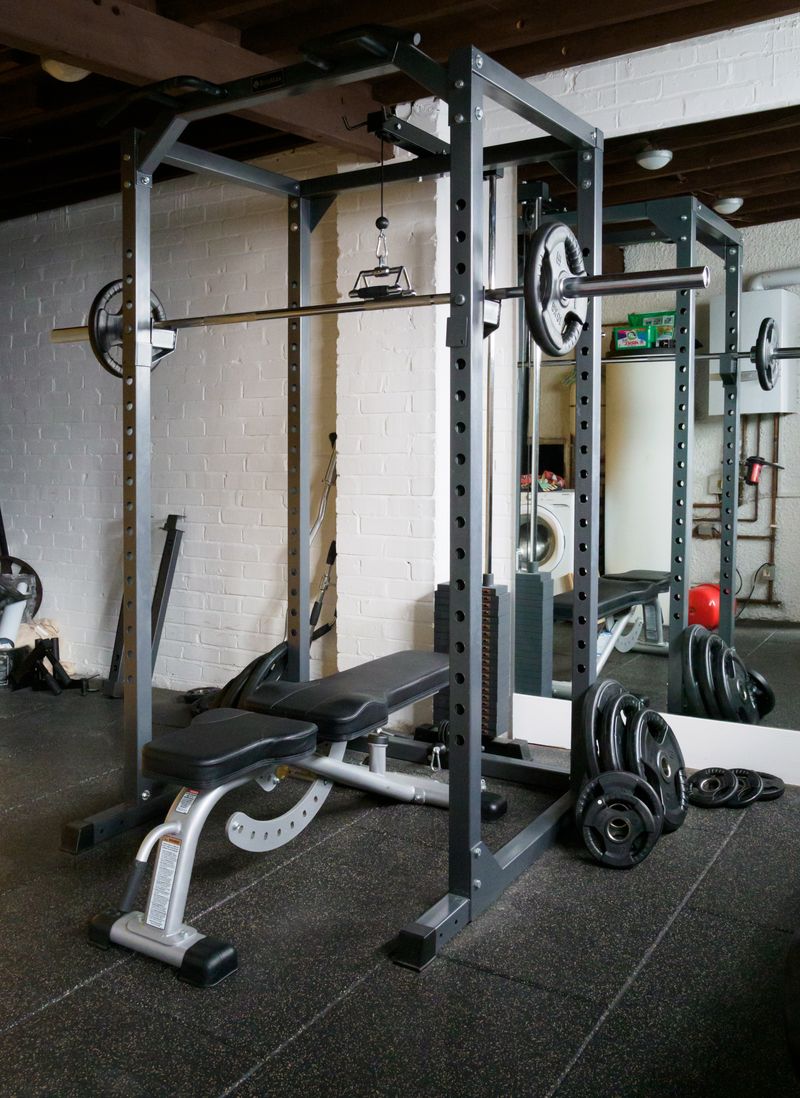
If you have a bit more height and a solid door frame, a low-mounted doorway bar still delivers true pull-ups and is the cheapest path at $25 to $35. Reserve the free-standing rack with a chin bar for rooms with full 8-foot ceilings, since it needs the most vertical space of any option here. Match the tool to your actual clearance, and a low ceiling stops being a reason to skip back day.
Building toward your first real pull-up
Low-ceiling alternatives are not just substitutes. Inverted rows and band pulldowns are how most people build the strength for a full hanging pull-up in the first place. Progressing the inverted row by lowering your body angle toward horizontal develops the same muscles a pull-up uses, in the same pulling direction. When inverted rows at a near-flat angle become easy for sets of 12, you have most of the strength a beginner pull-up needs.
If you do have just enough clearance for a doorway bar but cannot yet pull yourself up, combine the band-assisted pull-up with negatives. For a negative, step or jump to the top position with your chin over the bar, then lower yourself as slowly as you can, taking 5 seconds or more. The slow lowering builds strength fast and works in surprisingly little vertical space, since the hardest part happens with your arms already bent.
Suspension trainers versus rings in a tight room
A suspension trainer and a set of gymnastic rings both anchor overhead or to a door and both train horizontal pulls without ceiling height, but they suit different rooms. The suspension trainer has a single anchor point and fixed-length straps with handles, which makes it stable and beginner-friendly for rows and presses. It packs flat and travels well, and the closed-door anchor needs no hardware at all.
Rings give a wider range of motion and let each hand move independently, which builds more stability and carries over to advanced bodyweight skills later. For pure low-ceiling back training in a small apartment, the suspension trainer wins for most people because it is simpler to set up and forgiving on the joints. Choose rings only if you already plan to chase skills like muscle-ups or ring dips down the line.
🛠️ Free tools for this topic
No sign-up. They do the calculating and checking for you.
Published by the Gym4Home editorial team. Published October 13, 2026.
Editorial responsibility: see Imprint.
Spotted an error or have something to add? corrections@gym4home.com
Home Gym Tips, Weekly
Equipment picks, workout ideas, and setup guides — for every space and every budget. No fluff, just useful.
🎁 Free bonus: The Home Gym Starter Checklist (PDF)
You might also like
A Quiet 20-Minute Apartment Gym Morning Routine
A 20-minute quiet strength circuit you can do at 6am in an apartment without waking the neighbors below. Full routine and how to do each move.
A Home Core Workout With No Crunches (and Why That's Better)
A no-crunch core circuit you can do at home in 20 minutes, built on planks and carries that train real spinal stability.
Jumping Rope in an Apartment Without Annoying the Neighbors
Jump rope in an apartment without complaints. Why impact noise travels through the floor, how to build a quiet stacked surface, and the technique that keeps you silent.
📖 All articles on Gym4Home →
Browse our other articles