Strength Training for Seniors Over 60: A Practical Starter Guide
This article may contain affiliate links. If you make a purchase through these links, we may earn a small commission at no extra cost to you. This helps us keep creating free content.

Health note: This article is for general information only and is not a substitute for medical advice. Talk to your doctor before starting a new exercise programme, especially if you have an existing health condition or injury.
Adults lose roughly 3 to 8 percent of their muscle mass per decade after 30, and the rate speeds up after 60. Strength training is the one thing that reliably slows that loss, and you can start at any age. Studies of people in their 80s and 90s show muscle still responds to resistance work. Starting over 60 is not too late. It is one of the highest-return things you can do for the years ahead.
Two or three short sessions a week is enough to see a difference. You do not need a gym membership, heavy barbells, or a coach standing over you. A pair of dumbbells, a sturdy chair, and resistance bands cover the essentials. The goal is to keep the muscle that lets you carry groceries, climb stairs, and get off the floor without help.
Why strength matters more after 60
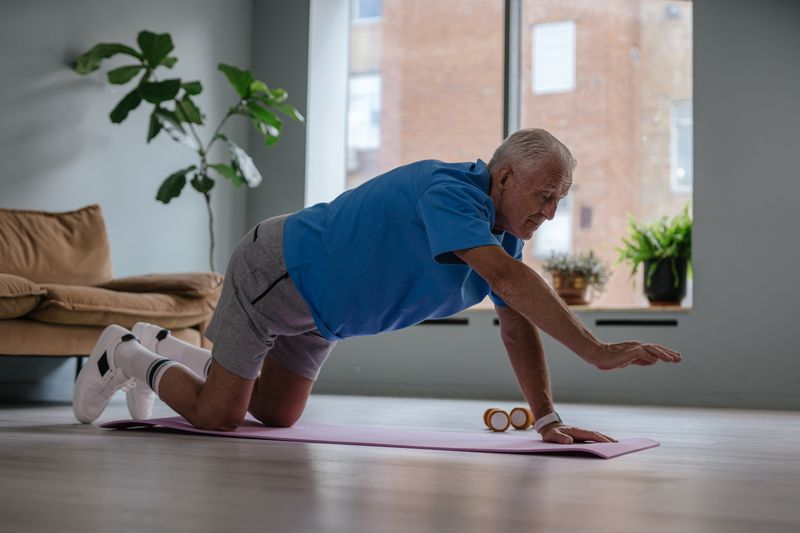
Muscle does more than move weight. It supports your joints, stabilizes you when you stumble, and keeps your metabolism from sliding. After 60, declining strength is closely tied to falls, which are the leading cause of injury in older adults. Stronger legs and a stronger core may help you catch yourself when you trip, and they make everyday tasks feel lighter.
Bone responds to load too. Resistance training places stress on bone that signals it to stay dense, which many people find helps offset the bone loss that comes with age. Combined with the muscle gains, that is a direct investment in staying independent. The reader who can still rise from a low chair unaided at 80 usually trained for it in the years before.
Start light and earn the weight
Fit Simplify Resistance Bands Set
Five resistance levels in a kit that fits in a drawer, gentle on the joints and ideal to start with.
As an Amazon Associate we earn from qualifying purchases.
Begin with a weight you can lift for 10 to 12 reps while keeping good form, with two reps left in the tank. For many people starting out that means 2 to 8 pound dumbbells, or even bodyweight and bands at first. The number on the dumbbell is not the point. Controlled movement through a full range is. Ego lifting is how beginners over 60 get hurt and quit.
Progress by adding a little resistance only once a movement feels easy for all your reps. This is progressive overload, and it works the same at 65 as at 25, just on a gentler ramp. Some weeks you add reps, some weeks a small jump in weight. Patience here pays off, because a strain that sidelines you for a month costs more than the slow climb saved.
Seven foundational exercises
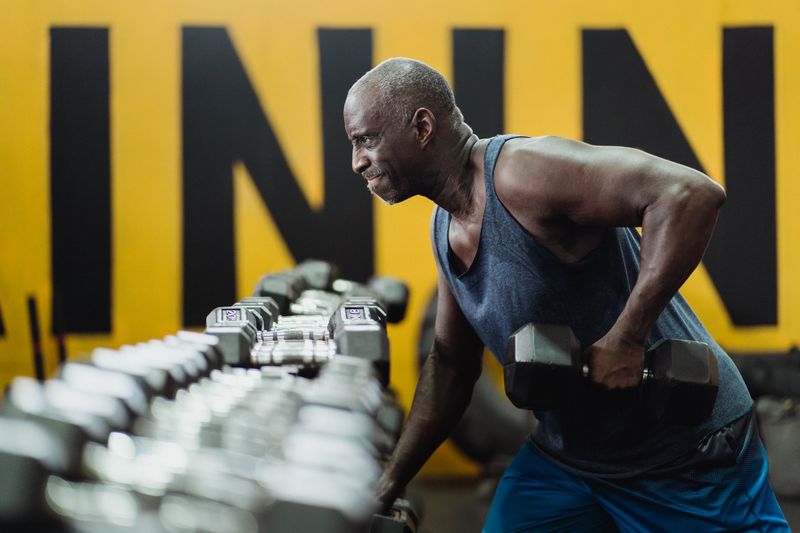
These movements train the patterns daily life demands: standing up, picking things up, pushing, pulling, and staying balanced. Do them as a circuit two or three times a week, resting a day between sessions. Start with one set of each and build to two or three sets over a few weeks.
| Exercise | How to do it | Sets × reps |
|---|---|---|
| Sit-to-stand | From a sturdy chair, stand up and sit down with control, no hands if possible | 2 × 10 |
| Wall or counter push-up | Hands on a wall or counter, lower your chest, press back | 2 × 10 |
| Seated or standing row (band) | Anchor a band, pull elbows back, squeeze shoulder blades | 2 × 12 |
| Dumbbell shoulder press | Press light dumbbells overhead, lower under control | 2 × 10 |
| Heel-to-toe stand (balance) | Stand near a counter, one foot in front of the other, hold | 3 × 20 sec |
| Calf raise | Rise onto your toes near a wall for support, lower slowly | 2 × 12 |
| Dead bug or seated core brace | Tighten your core, move opposite arm and leg slowly | 2 × 8 each side |
If a movement causes joint pain (not muscle effort, but sharp or pinching pain), stop it and ask a doctor or physio for a substitute. The sit-to-stand and the row are the two highest-value exercises here because they train the legs and back, the muscles most tied to independence.
Equipment that fits a home and a budget
You can start with almost nothing. A sturdy dining chair handles sit-to-stands, and a wall handles push-ups. From there, the highest-value buys are light adjustable dumbbells and a set of resistance bands. Bands are easy on arthritic joints because the resistance is lowest at the start of the movement, where joints are most vulnerable, and builds as the muscle reaches its strongest position.
| Item | Approx. US price | Why it helps |
|---|---|---|
| Resistance band set | $20–40 | Joint-friendly, scalable, stores in a drawer |
| Light adjustable dumbbells | $100–250 | One pair covers many exercises, easy to progress |
| Sturdy chair (already owned) | $0 | Sit-to-stands, support for balance work |
| Non-slip exercise mat | $20–40 | Cushions floor work, prevents slips |
Building a weekly schedule
A simple weekly plan keeps you consistent without overthinking it. Two full-body sessions a week is the floor that produces results, and three is better once your body adapts. Leave at least one rest day between sessions that work the same muscles, because the muscle rebuilds on the off days, not during the lifting itself. A Monday and Thursday split, or Monday, Wednesday, Friday, both work well.
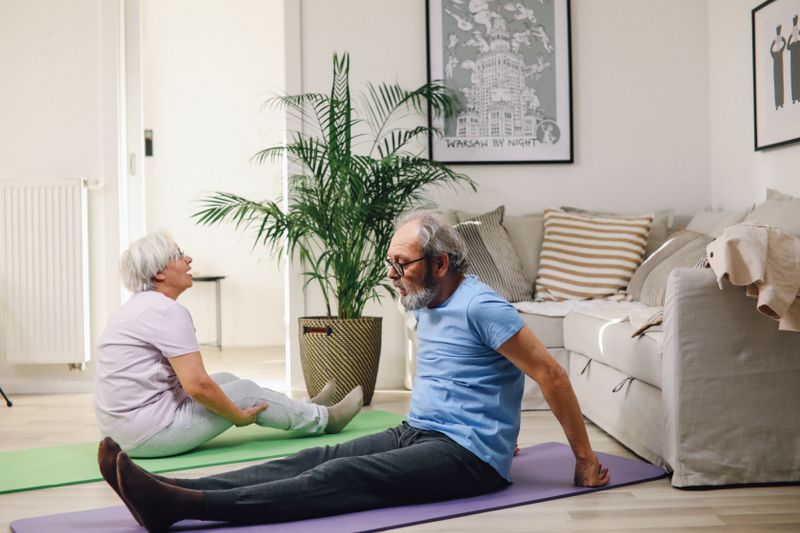
On each training day, run the seven exercises as a circuit: one set of each in order, rest a few minutes, then repeat for a second and eventually a third round. The whole session takes 20 to 30 minutes once you know the movements. Walking, swimming, or cycling on the off days adds heart and lung benefit without interfering with strength recovery, and many people find that mix easier to stick with than lifting every day.
Track your sessions in a notebook or a phone note. Writing down the weight and reps for each exercise turns vague effort into visible progress, and it tells you exactly when a movement has become easy enough to add load. That record is also the simplest motivator on a low-energy day, because the trend over weeks is hard to argue with once it is on paper.
Train safely and recover well
Warm up for five minutes before lifting with easy marching, arm circles, and a few slow sit-to-stands. Cold muscles and stiff joints are easier to strain. Breathe out on the effort and never hold your breath through a hard rep, since breath-holding spikes blood pressure, which matters more for older adults.
Recovery is where the strength is built, not in the session itself. Leave at least a day between sessions for the same muscles, and protein at meals supports the repair (your doctor or a dietitian can advise on amounts for you). Sleep matters as much as the training. If you feel run down or a joint is flaring, take an extra rest day. Consistency over months beats intensity in any single week.
Frequently asked questions
Is 60 too old to start lifting weights?
No. Research shows muscle responds to resistance training well into the 80s and 90s. The starting point is lighter and the progression slower, but the gains in strength and daily function are real at any age.
How often should I train?
Two to three sessions a week on non-consecutive days is the sweet spot for most people over 60. That gives muscles time to recover and rebuild between sessions.
Will lifting weights hurt my joints?
Done with light loads, full control, and good range, strength training tends to support joints rather than harm them. Many people find it eases joint discomfort over time. Sharp pain inside a joint is a signal to stop and get advice, not to push through.
Do I need a gym?
No. A chair, a band set, and a pair of light dumbbells cover everything in this guide at home. A gym adds options later if you want them, but it is not required to start or to keep progressing for a long time.
🛠️ Free tools for this topic
No sign-up. They do the calculating and checking for you.
Published by the Gym4Home editorial team. Published October 12, 2026.
Editorial responsibility: see Imprint.
Spotted an error or have something to add? corrections@gym4home.com
Home Gym Tips, Weekly
Equipment picks, workout ideas, and setup guides — for every space and every budget. No fluff, just useful.
🎁 Free bonus: The Home Gym Starter Checklist (PDF)
You might also like

How to Build a Home Gym After 60 on a Budget
A practical, budget shopping list and starter routine for building a joint-friendly home gym after 60, with US prices and where to spend versus save.

Best Home Gym Equipment for Seniors Over 60: What Actually Works
A practical, joint-friendly home gym for people over 60, ranked by value and adjustability, with approximate US prices and a sensible buy-in-order plan.
Foam Roller Guide: Types, Density and How to Use One
A practical foam roller guide covering density, length and texture, how to pick your first roller, and a step-by-step routine for the main muscle groups.
📖 All articles on Gym4Home →
Browse our other articles